What the Heck, German Army?: Another Four Tapes
11.6.18 by Ryan Masteller
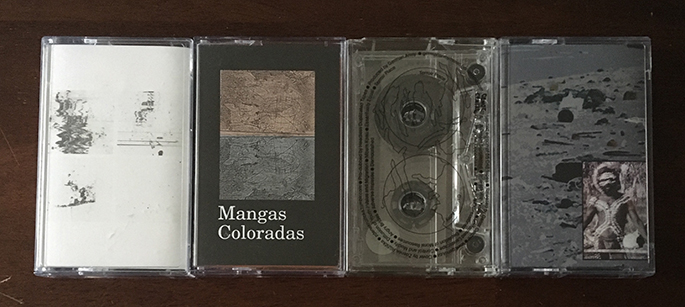
I thought it might be interesting to try a little experiment. Being the enterprising moron that I am, I played three of the four recent German Army (the good one) tapes simultaneously to see if the result would bug me out enough to abandon the experiment before it really got going – you know, “Zaireeka”-style. You’ll be happy to know that I made it all the way through the first several tracks of “Vieques” (Madriguera), “Mangas Coloradas” (Muzan Editions), and “Terroir Place” (Genot Centre) before I abandoned it because I couldn’t focus on what I was writing Marge is this a pimple or a boil? The result was not crazy – sure, the tracks competed in a way that I wasn’t used to hearing, but overall the mood of each piece fit: the murky abstractions of “A Bedsheet” blended well with the gritty string samples of “A Dream Supplanted,” all underscored by the tribal rhythm of “Obscuring Origin.” Sounds like a GeAr remix album. Speaking of which, who’s doing the German Army remix album (which will probably just sound like German Army in the end)?
These tapes continue the German Army modus operandi of presenting a historical or topical event/person/situation, extrapolating on it for the length of an album, and drenching it in the duo’s trademark warped tribal/industrial/post-ambient moods. What do they have in store for us this time?
–“Vieques” is named after the Puerto Rican resort island, which was devastated by the passage of Hurricane Maria. The rhythms of a hardscrabble life in the aftermath punctuate the album. (We all know how the United States responded to that disaster. It wasn’t pretty.) Also, the US Navy once used the island as a “bombing range and testing ground,” at least until they were protested the hell out of there. I’m not 100 percent certain, but I think I sense a pattern of the United States behaving poorly in situations of humanitarian crisis in German Army’s work… Whoa, wait, is that singing?
–If it’s even possible, “Mangas Coloradas” is a much more somber affair – a reverence hangs over the work, which shifts into dulled anger and back again with barely a ripple. Coloradas was an “Apache tribal chief” known for “his fighting achievements against the Mexicans and Americans.” He was hoodwinked by “Brigadier General Joseph Rodman West, an officer of the California militia and a future Reconstruction senator from Louisiana,” which led to his doom. As he arrived to meet with West under a flag of truce, he was instead seized, tortured, and killed. Diplomacy at work! Anyway, “Magnas Coloradas” is definitely among the bleaker pieces in German Army’s catalog.
–“Terroir is the set of all environmental factors that affect a crop’s phenotype, including unique environment contexts, farming practices, and a crop’s specific growth habitat. Collectively, these contextual characteristics are said to have a character; terroir also refers to this character.” I learned all about that in “Authority,” book two of Jeff Vander Meer’s Southern Reach trilogy. Scientists used the idea of “terroir” as a lens through which to view Area X. We can apply this to German Army as well. What is German Army’s “terroir”? How does it manifest itself to the world? Well, the answer lies, at least a little bit, in stuff I already wrote up there. But maybe the duo is applying their critical eye to farming practices too? Aren’t smallholders and subsistence farmers in steep decline worldwide? Aren’t farming regulations particularly fucked to favor corporations, especially in the United States (ahem, Monsanto)? Is that Norelco fucking ETCHED? God that looks gorgeous. Hope it doesn’t break.
—Juan Neopmuceno Cortina Goseacochea has been called the “Red Robber of the Rio Grande” and the “Rio Grande Robin Hood,” a particularly apt subject for the GeAr-heads to tackle. The “first ‘socially motivated border bandit,’” Cortina’s militia was driven into Mexico following the country’s defeat in the Mexican-American War in 1848. German Army conjures the wilderness of the Rio Grande borderlands on “Nepumoceno Cortina,” a dry, dusty collection of fritzed electronics. This is also the newest of the four tapes, not even released as of this writing! You’ll have to wait until Halloween for that. (Or, if you read this after Halloween, it might be sold out from Denver’s Cloister Recordings. Edition of 100, 5 left!)
Four distinct pieces of the German Army puzzle, four fantastic odes to the plight of the average person. Do NOT let injustice win out. Let’s all get angry at something worthwhile and do something about it.