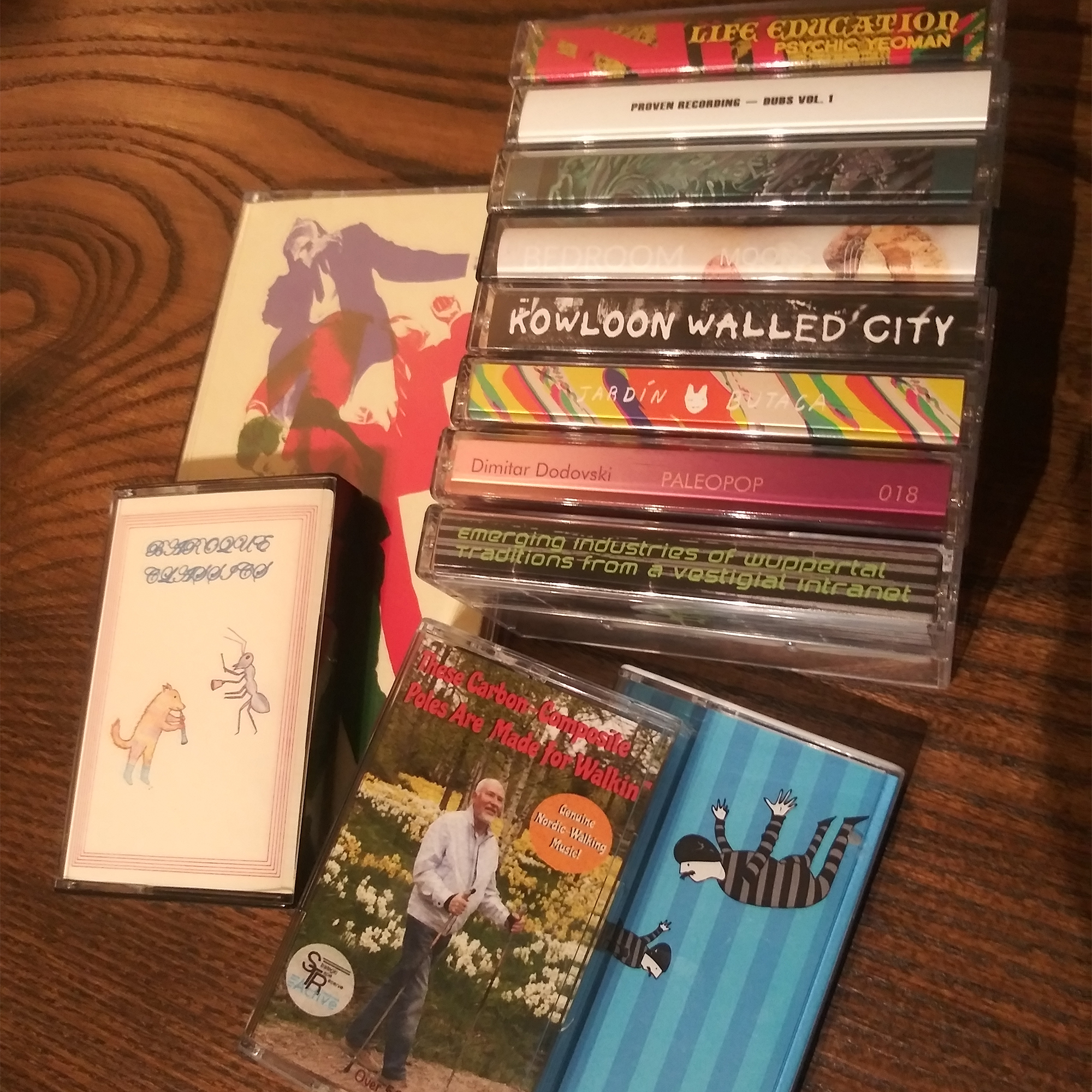
Dimitar Dodovski – Paleopop (Become Eternal)
Ebauche – Formic Syntax (Cosmic Winnetou)
Bedroom – Moons (Fluere)
Emerging Industries of Wuppertal – Traditions from a Vestigial Intranet (Strategic Tape Reserve)
Fitness Instruktör – These Carbon-Composite Poles Are Made For Walkin’ (Strategic Tape Reserve)
The Tuesday Night Machines – These Carbon-Composite Poles Are Made For Walkin’ (Strategic Tape Reserve)
Proven Recordings – Dubs Vol. 1 (self released)
Nick Hoffman – Baroque Classics (For Electronic Oscillators) (Pilgrim Talk)
Smith Comma John – Watch A Man Die Trilogy (self released)
Jarvis Probes – Something About Hands (Wolves Productions)
Jardín – Butaca (Freaks)
Life Education – Psychic Yeoman (Null Zone)
German Army – Kowloon Walled City (Null Zone)
Space Age Pressure Pad #4: The Ataraxia meditation series on Crash Symbols 10.12.18 by Scott Scholz
During the first round of “cassette culture” in the late 70s and 80s, all kinds of less-commercial music that the big labels didn’t want to touch blossomed on tape. From noise/improv experiments, to homegrown weirdo songwriting, to new age musical mood stabilizers, artists and audiences did their own thing in the absence of outside pressure, and found each other through the mail. These DIY and DIO (“do-it-ourselves,” my preferred way of looking at it) scenes are often discussed in terms of the punk rock ethos, and that’s certainly true, but I think it’s also fair to say that the new age movement was even more punk than punk when it came to taking control of their own destiny. From these scenes, we were gifted with the beginnings of the mellow synth zoners, east/west sacred fusions, and serene field recording scenes we still enjoy today.
One area of the “cassette revival” that hasn’t reached back so much to the OG scenes, though, relates to meditation tapes. One can get on eBay to find the vestigial remains of guided meditation jams, often issued in series form on tape and later CD, that straddled a line between spiritual practices, self-help, and new-at-the-time tech ideas like subliminal encoding, but there hasn’t been a ton of action lately tapping into that stream. Enter Ataraxia, a new series from Crash Symbols!
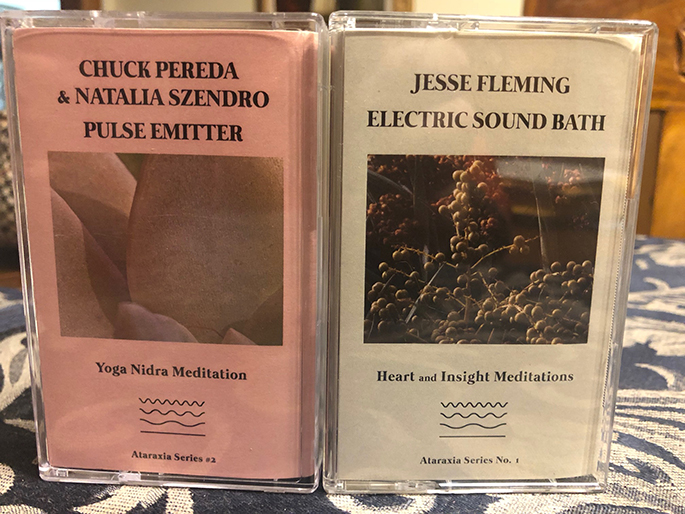
The Ataraxia series was launched last year with “Heart and Insight Meditations” by Jesse Fleming, accompanied by the music of Electric Sound Bath. Fleming’s delivery, a gentle West coast seaside patois, is dressed in a bit of reverb, and combined with the subtle dynamic shifts of Electric Sound Bath, sounds especially good to me cranked through a nice pair of speakers. Lay down, close your eyes, and you can easily slip into an imaginary group setting and ride some peaceful waves with this very live-sounding recording. Or you can slump back a little in your favorite chair and vibe on the video Electric Sound Bath produced to accompany the A-side of this recording:
It’s no accident that this collaboration takes on such a fresh, extemporaneous kind of live feel: Electric Sound Bath and Fleming collaborated on a regular “Sunday Sit” mindfulness series at the 356 Mission Gallery in LA (RIP), and the music featured here was captured from the first two of those sessions in 2015. For those of us who live in places that generally don’t have a lot of sessions like this, this tape is a great way to feel connected to the contemporary mindfulness scene.
This year, Ataraxia Series #2 has arrived, featuring Chuck Pereda and Natalia Szendro as your meditation guides, with some deep synth zoneouts by Pulse Emitter as support. I found this one to be more effective as a headphone kind of jam–the voice recordings here are clean, dry, and present on this tape, and feel like they’re going right into your brain if you go the Walkman route. Daryl Groetsch/Pulse Emitter makes the perfect accompaniment here, with a beautiful, memorable thematic idea that’s quite soothing yet invigorating during the Introduction section, becomes more subdued and tender during the main Meditation, and returns gently to the theme at the Comedown.
Mexico City DJ Chuck Pereda proves to be a very astute practitioner of the Yoga Nidra Meditation practice, delivering a very thoughtful English-language abridgement of a traditional Yoga Nidra script, and then translating the whole thing into Spanish for side B. Very awesome to think of how many more folks might find this tape useful from the bilingual approach alone! Pereda opens and closes the tape, with Natalia Szendro taking over the main guided meditation section in the center. It all sounds beautifully polished and utterly present and like the sort of thing you’d have to pay a month’s rent to experience at some fancy retreat. But you can still snag your very own copy of this one over at the Crash Symbols Bandcamp page.
I’m very excited about the future prospects for this series, and wondered what the Crash Symbols folks might have in store, so I fired off some questions to their HQ in West Virginia to find out. As expected, lots of interesting plans are afoot, and I learned about a couple of new-to-me labels worth checking out along the lines of contemporary aural meditations, too. Read on, friends, as Dwight Pavlovich spills the beans–and who doesn’t love beans?
It looks like you’re planning to nest the Ataraxia series within the broader Crash Symbols catalog, as opposed to splitting it off as a discrete sublabel. How do you see the series in relation to the more stylistically-dispersed discography of Crash Symbols?
Dwight, Crash Symbols: I don’t instinctively see a separate identity adding value for us or listeners. We do have specific intentions for the series within the catalog, but they overlap with our larger goals generally – I guess that’s why it seemed sensible to handle somewhat together. We’re trying to put out tapes and records that are fun, interesting, or engaging in different ways, and I think our take on guided meditation feels worth exploring alongside other sounds.
Having said that, I do think the overlap will make more and more sense as the series fleshes out.
I find the name of the series itself fascinating, as it points toward a kind of meditative experience that is more active than passive. Is there a particular school of philosophy or a specific meditative practice you’re drawing from as initial guidance?
No, but I’m glad that’s how you read it! We hope the name communicates that direction. Calmness, serenity, etc, that’s all fine, but it’s the element of balance between inner and outer spaces. If you just google around a bit I think the most satisfying short definition you’ll find is “robust equanimity.” Going back to your last question a bit, we like the idea of active renewal, and we see music and guided meditation as similarly connected to the sort of interior practices that build a rigorous awareness of context and self.
Are you planning to focus the series on guided meditations or will some installments be instrumental?
We will probably have some instrumental releases, and at least give more options for how to listen to each new installment. I think there are lots of labels that do ambient music extremely well, that live up to a genuine range of the associations and expectations listeners might have for that dimension, but not much I would compare to what we’re imagining.
We have had some pleasant surprises though. This year Matt and Ash’s wonderful Flower Room imprint has been doing some great stuff in a related vein. We’re just finishing up prep for a release with Matt, but we’re also hoping that we can all collaborate within the series before too long.
Thinking of the work of Electric Sound Bath on the first tape in the series, is there a bit of kinship with the Deep Listening concepts of Pauline Oliveros? I’ve long thought that portions of her catalog walk a very interesting line between high-focus listening and a more meditative experience, though still on the lucid side of things, which again makes me think of the state of Ataraxia. And of course I’m wondering if there’s any considerations along these lines related to subsequent releases as well…
Absolutely, and at this stage at least I imagine an instrumental experience would build on that premise of deep listening.
Folks like Fleming that do a lot of mindfulness work across multiple media platforms make me wonder about the nature of the Ataraxia series in terms of your own “vibe” around it: is it intended to feel like a bit of a “throwback” to the meditation tapes of the 80s that were quite common, a new thing, a bit of both, up to the listener…?
I think we connect our nostalgia for the “vibe” with our optimism around the practice. We’re not really aiming for a throwback, so much as a continuation, by connecting as responsibly as we can with what we can – in short, a bit of both!
There can be a fine line though. A lot of new age material has traditionally worked in a palette that’s meant to be accessible and encouraging, so occasionally it seems weird to see how labels or designers perhaps unconsciously enforce more dogmatic aspects of traditional practice.
Along the same lines, might there be any multi/intermedia projects in the future of the project, like including video images, incense or aromatherapy resources, etc, bundled with tapes?
Absolutely! Brian from Electric Sound Bath did some simple visualizations for volume one, but we are excited to think about more when the time comes. Soap Library is a groovy label that’s done some cool stuff in that vein.
Any future Ataraxia releases you can talk about yet?
We have a sort of multimedia stage meditation developing with our friend Jon Bernson in San Francisco. The final form may evolve, but we’re excited to see where he takes it.
We also have at least four more conventional pairings of musicians and readers.
This may differ on subsequent releases, of course, but is there a general plan to have one full meditation per side of tape, or should listeners plan to listen to both sides in relatively quick succession?
Right, generally we’re planning to have two sides of distinct content – whether it’s two meditations or one meditation in two languages. That may change case by case, but the goal is to give listeners something substantial with each release.
Stephen Molyneux – A Jaguar Mask 10.11.18 by Ryan Masteller
Northern Floridians: There’s only one thing that comes to your mind when you think of “jaguar mask,” right? Something like this, or this, or maybe even whatever the hell this is. Maybe this. Certainly this. But we’re a different breed, you and I, and when it comes to music, the words “A Jaguar Mask” conjure up only one thing: fight songs.
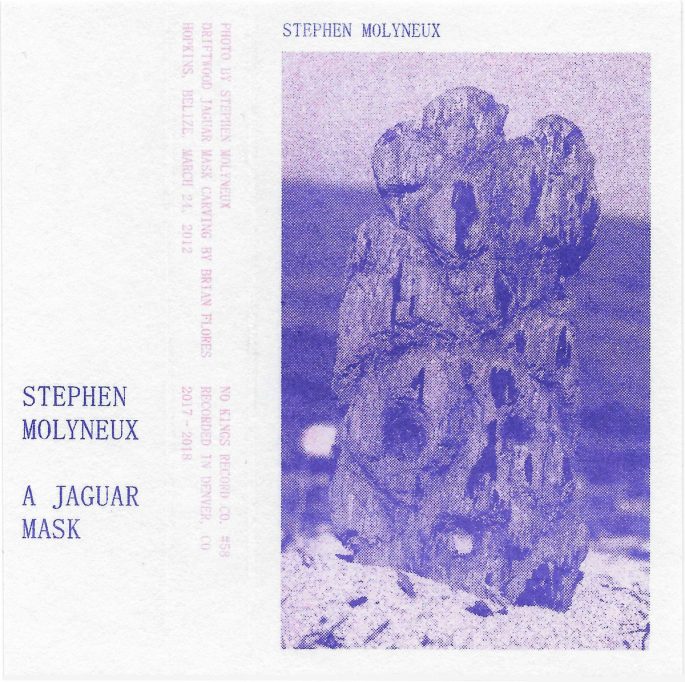
But we’d be wrong – dead wrong – in our assumptions in this instance, because what we’re dealing with here has nothing to do with football or northern Florida or anything remotely approaching a rhythm to stomp around to. No, here we mean Stephen Molyneux’s “A Jaguar Mask,” a cassette release on No Kings Record Cadre that features a “driftwood jaguar mask carving by Brian Flores, Hopkins, Belize, March 24, 2012.” It doesn’t look much like what I linked to in the previous paragraph, but the carving itself, especially presented in the filtered photograph above and displayed on the stunning risograph Jcard, is a sight to behold. It is after this piece that Molyneux titled his tape.
And there probably aren’t a lot of “outsider folk” artists who get compared to something like the Jaguars’ D-Line, and I certainly won’t be the first – I’ll even make it a point to say that “A Jaguar Mask” sounds nothing like an all-percussion ensemble. No, the Colorado-via-Tennessee Molyneux is much more nuanced, much less bombastic in his performance. In fact, we can refer to the cover again to inform our expectations about Molyneux’s music, because, as they saying goes, you can ALWAYS judge something by its outward appearance, books, cassette tapes, or otherwise.
So the hazy textures of Molyneux’s treated guitar and various keyboards are as timeless and familiar as the driftwood photo, grounding in the immediacy of one’s reactions to them yet ethereal as they float on the edges of memory. And while the shelving category is quite obviously “ambient,” snatches of melody sneak in through and infiltrate the foreground, laying the groundwork for the emotional reactions you’re sure to have. It’s quite simply gorgeous stuff.
The cross-section of the Venn diagram with “Jacksonville Jaguars fans” on one side and “Stephen Molyneux fans” on the other is very, very thin, I imagine. It may only be yours truly in the middle, come to think of it. But hey, somebody’s gotta occupy that unique space – might as well be me.
Grab a handful of these lovely cassettes and hand em out as party favors at your 2019 Super Bowl party, an event that will, of course, feature the Jacksonville Jaguars. Edition of 75.