Cranky Bow – The Blue Ball Session
10.12.20 by Matty McPherson

Cranky Bow – The Blue Ball Session
10.12.20 by Matty McPherson
10.12.20 by Matty McPherson
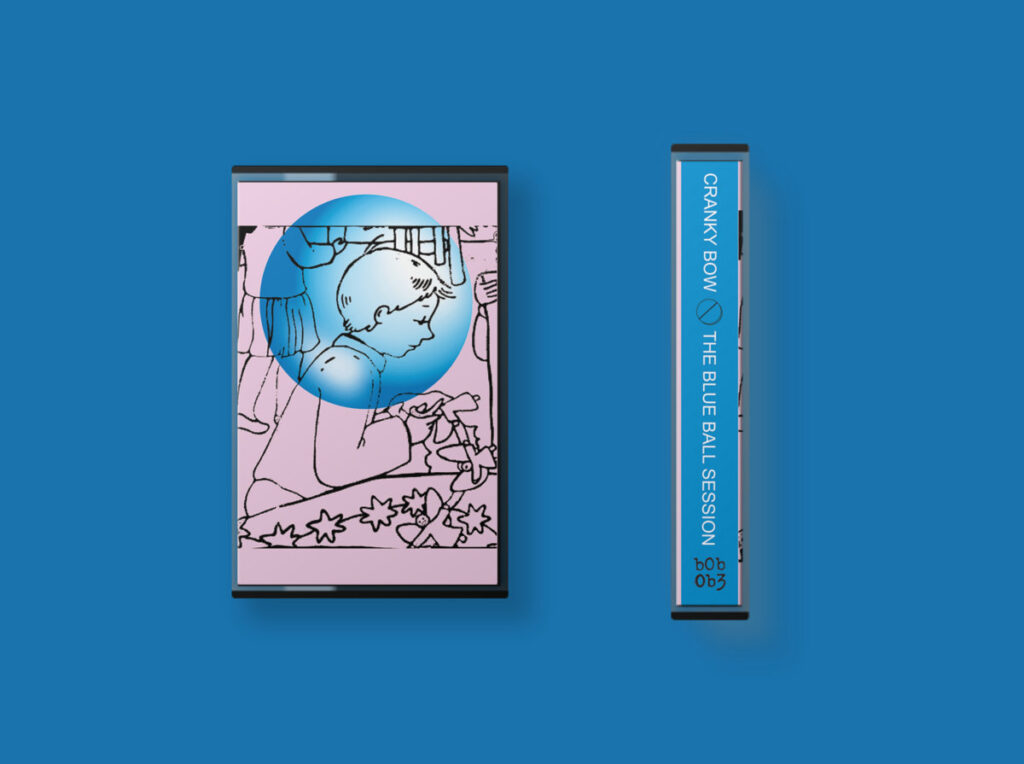
I assure you that Cranky Bow is not trying to rob you of any pleasure during the “Blue Ball Session”, an unnamed two part odyssey from the twisted mind of Gábor Kovács. His reputation over the last decade has been a steady one, transitioning from one alias to another moniker without ever stopping a consistent output of abstract and devious technological music-for European labels of course!
“Blue Ball Session” sees Kovács going one step further with the Cranky Bow moniker, introducing elements of library music while keeping things in a delicate lo-fi balance. Part 1-perhaps better known as “There’s ‘Hell’ in Hello, But More in ‘Goodbye’”, opens with a “Goodbye!” that last 400 times as long as an Irish goodbye, with the faint pulse of what is akin to train wheels on the tracks. As it traverses away past the salutation, it becomes apparent that you, dear listener, have arrived at a resting place. A light synth welcomes you to a burial ritual in the graveyard of broken dreams. As it mutates and welcomes in odd percussive elements, the track still never loses its simplicity or desolation. The spaciousness provided by the track is indeed perfect for that room clean or when you need to find your dead wife in a small American suburb.
Part 2, also known as, “Cranky Bow is murdering the Hannah Barbera sound effects library!” is much more playful with the samples and noises that appear. No longer are you in the graveyard, but in the haunted train track (with a light piano playing) and…“is that the sound of an energy charge or spring loaded trap going off?”-I don’t know either, but it keeps the haunted train track piano going until suddenly the track introduces a warped library sample of horns, organ, and tip-toe indebted percussives. It’d fit like a glove in the hands of Jules Dassin, perfect not just for those noir soundscapes, but the tension offered from the heist. For the track’s back half, the tension seamlessly builds with the percussives and horns becoming less tethered to typical sound structures, popping in and out like it is death by a thousand cuts. As it ends with a vocal sample of a man speaking, probably sitting at a jazz lounge contemplating the things only a man can do, for the first time during the tape, you feel safe.
Library music is still a genre I rarely interact with across these cassettes. Understandably so, this is music made for the cheapest of cheap seat shows or the b-movie. Yet, seeing Kovács’ ability to squeeze it for the tension while stripping these samples of their temporality has kept me coming back. Talk about “Goodbye!”
From Vadlovak Records
10.8.20 by Ryan Masteller
I made a few Little League all-start teams in my time, because I was pretty good at baseball. My game was pretty well-rounded – I could hit for average and power, I was fast, I could field. So they lumped me in with the other “best of the best” kids, and we held exhibition games against each other. All that talent in one place, under one banner – it was pretty amazing to be a part of, and probably to witness. Just ask any of the dozens of shrieking parents present for those games – they’ll tell you.
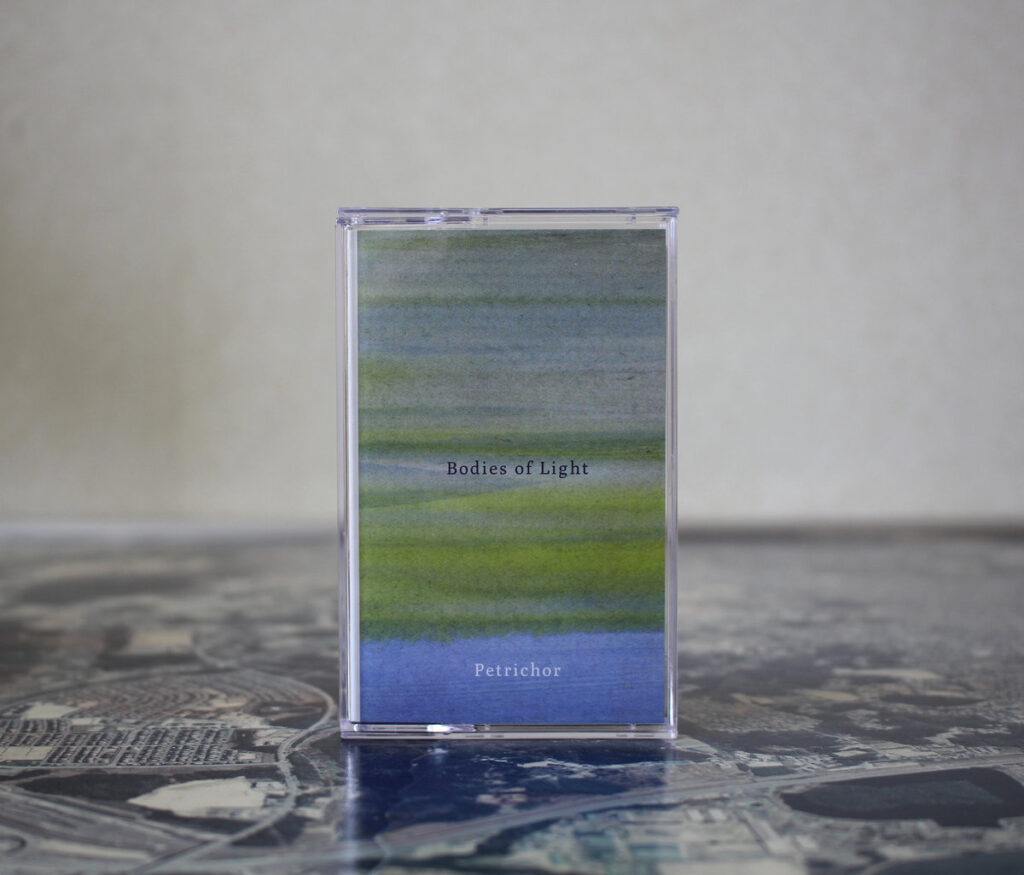
Bodies of Light is like an all-star team, except instead of baseball, it’s an all-star team of experimental electronic drone music. Sort of the same, but not really. Instead of nine participants, Bodies of Light has only two: Peter Taylor, of MAbH (aka Mortuus Auris and the Black Hand) and yama-no-kami fame, and Nicholas Langley, showrunner of Third Kind Records (and Tabs Out celebrity) and solo musician/participant in such groups as Erm and Nickname and Vitamin B12, among others. But they don’t need an additional seven people to make the wonderful magic that they do, to prove to their hysterical fans that the wait was totally worth it.
And they’ve already sort of worked together – Nicholas has released Peter’s music after all. But in a fully collaborative environment, even though it’s virtual (London and Brighton are separated by a 60-minute train ride, but these are the days of COVID), the two shine brightly. “Petrichor” is chock full of the deeply personal environments that Peter and Nicholas are so good at creating on their own, and the synthesizer sweep of the tunes, peppered with spoken samples and other accoutrements, like the delectable piano loops of “Screen Memory,” serve to block out any external interruption. This is the stuff to get lost in, to listen to on headphones and absolutely escape. Taylor and Langley are at the top of the game with this stuff – they have few equals.
And of course, any really good team has to have a really good coach, and Peter and Nicholas have found one in Muzan Editions. Well, by coach I mean label to release the music, but you get the idea. If it’s Muzan, it’s quality! That’s no joke.
Related Links
10.8.20: 291
10.8.20: Bob Heavens