Les Horribles Travailleurs – Late 1988 -Early 1989
11.3.22 by Jacob DeRaadt

Les Horribles Travailleurs – Late 1988 -Early 1989
11.3.22 by Jacob DeRaadt
11.3.22 by Jacob DeRaadt

These burst of rapid-fire tape collages from Dutch squatter Les Horribles Travailleurs have a succinctness and development in character of sound that inhabits sparse territories of ruptured tape heads and visceral editing. Created are unique intervals of cut-up, lo-for-tape sounds at the beginning of side A thar remind me of Etant Donnes. Full rapid-fire eye movement successions of squirrel song tape fluttering sounds that get submerged under total spaces of black. There’s an episodic treatment to the sounds and a stop, start, stop feel to any momentum that might develop when I start to recognize repeated sound world fragments reappearing ever so occasionally. Again, a black space underneath all of this warbling cut up physical tape noise that swallows it all. //End of first piece.
The second piece has an industrial percussion sample loop that builds in primitive release and intensity. Very much a confusion of what is man made and what is field recordings here. A great quality to have in sound of confusion.
Other pieces on this side have a very ghostly deserted feel to them, almost musically approaching ambient. Total confusion as to what instruments or devices produced these sounds. The tape obscures everything perfectly and binds them together in the muck, then certain elements will almost take a step forwards in the mix and change character in one aspect or another simultaneously. Somber and direct combinations of tonal fidelity close out side one, gutted fidelity adding to the compositions unique consciousnesses.
Side two builds moods of grittiness and droning intensity in a way that makes it differ a bit from the approaches on first side. What sounds like hissing sewer gates begin to overlap with grinding mechanical dysfunction, things start to solidify into a noisy surge ending in a dying hiss. Then we’re back to the rapid-fire cut up. Harsh and banal moments juxtaposed and speed processing employed in full effect. Chopping rhythms cutting in and out of the mix, gurgling tape syrups groaning beneath sped up elements.
Consciousness disruption.
an Email from Chris Gibson of Buried in Slag and Debris, Oct 2021:
The project’s name is ‘Les Horribles Travailleurs’ or ‘les horribles travailleurs’ – French for ‘The horrible workers’, which is a term from one of ‘the letters of the visionary’, written during 1871 by Arthur Rimbaud.
https://www.mag4.net/Rimbaud/en/DocumentsE1.html
‘late 1988 – early 1989’ is the name of the series of sound works.
Some notes:
‘late 1988 – early 1989’ – Les Horribles Travailleurs’
Selections from : ‘o/r/g/v/m/c-z – tape nr. 91’
Roughly this series is the result of two different forms of working with sound:
The collage\cup-up form and the more ‘musical’ form, but very reduced form of it, the music elements as rhythm and melody being almost drowned in its liquid state as pure sound.
The first form corresponds with the transformation of urban and industrial landscapes and architectural and mental constructions to raw material, basic states, elemental forces.
The second one corresponds with the inward view – a descent inside the body – with its pulsations, rhythms, cycles and silent mysteries. The dialogue with raw bodily materials and elemental natural phenomena as another way to reach a basic state.
These sound works are not the result of a concept – and are not created for an audiance, but were organised to function as poetic methods of research and trasformation:
“within this violent language, within this violation of language – a source was discovered”
(Les Horribles Travailleurs).
Les Horribles Travailleurs: sound project by Max Kuiper, The Netherlands.
Started with the purchase of a cassetterecorder and the recordings of the action of breaking glass, both on 15 january 1982.
Initially named ‘o/r/g/v/m/c-z’, later Les Horribles Travailleurs.
This series of works were recorded with a small number of cassetterecorders, a reel to reel machine and a simple sample keyboard, late 1988 – early 1989.
All sounds are from recordings made from 1982 to 1989: a variety of methods and sources were used: field recordings, concrete materials such as stone, glass, water, wind, metal objects, radio, television, record player, musical instruments, recordings in abandoned factories and houses, cellars, attics, empty rooms, wastelands.
\
Visual works: a combination of drawings, photos and writings made from 1978 on – and found images and words.
Drawings with ink, felt tip pen, spray paint.
Writings with typewriter, stamps, rub on letters, newspaper, letter templates.
Combinations and photos of broken vinyl record, knife, medical instruments made in 2021 by Max Kuiper
11.2.22 by Matty McPherson
11.2.22 by Matty McPherson
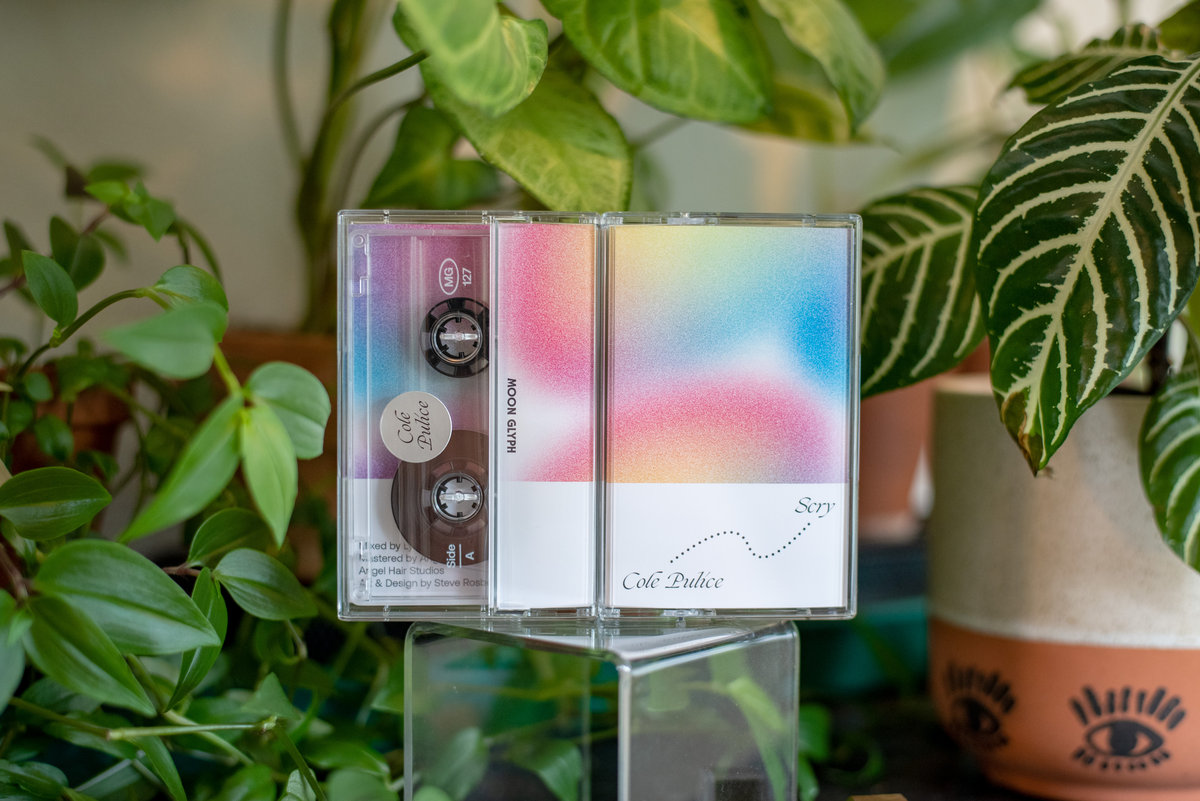
I am still most fascinated about Cole Pulice’s approach to an oatmeal breakfast. Whereas many of us look at the template and decree “Sweeten it! Throw down chocolate or brown sugar!” Cole instead considers how a savory mending of flavors (kale and garlic cloves) can open a new pathway from a rigidity set tradition. It’s the same base but a whole new class of thinking.
Pulice’s music has a variety of tags and eccentricities that as well, expand our ways of thinking. The kinds that lightfully tease and playfully stretch the ways in which one can approach their digitally processed saxophone recordings. We’ve seen their work in two labels and one consistent collaborator (Lynn Avery, aka Iceblink) that seems to be fostering these sounds with a curious open heart: Orange Milk and Moon Glyph. For the former label, the LCM Signal Quest tape of fall 2020 is perhaps the greatest introductory text into the world of “goo core”: noise being approached like bright, malleable plato instead of crushing, carbon-black steel. For the latter label, Pulice has been tied to “ambient jazz,” a moniker that moonlights more as a non-de-plume for people who need a shorthand to easily establish more free-form, textured recordings that just happen to be based around synthesizers and brass instrumentation.
That isn’t to say that the work Pulice has been doing over the past 2.5+ years, which has slowly teeterd out at the behest of delays or other discrepancies, does not intersect with a jazz context. Their CV on the Moon Glyph label–features on Lynn Avery’s 2020 Iceblink LP, their blissed out duo tape from February, and Pulice’s previous solo album, all albums that timespend and pitch shift reliable jazz contexts into personable, warped adventures. All of these releases have been quite exceptional in their ability to “zone”. Yet Pulice’s latest, Scry, is the first release where I feel as if the Oakland/Minneapolis artist has hit a tremendous stride in capturing the blissful quirks of digitally processed saxophone and (wind) synthesizer that imagines a true open world.
Scry’s near-three year development, articulated into the C28’s 8 cuts, willfully invokes 20th century electroacoustic mavericks. Hassell, Behrman, Oliveros, Budd, Brown, & Payne are all alluded to as points of interest. Pulice’s fascination with the mending of hardware and software found in these maverick’s projects inspired themself to create their own pedal board set-up where they are able to control the signal processing in-real time. Even still, Pulice’s approach is deeply playful and jubilant, not merely attuned to just perfoming a tribute as a stock classicist would. Within this approach Pulice parallels the nativity and utilitarian awe of those electroacoustic pioneers, capturing lightning in a bottle experiments and balladry that eclipses kankyō ongaku.
One humongous factor that simultaneously separates Pulice from the classics and advances their own electroacoustic vision is their devout adherence to a “gamer logic”, as it could be dubbed. The lad carries a knowledge base and dedication to the run of 90s Square SNES and PS1 RPGs. I would not be surprised if they have spent time in video game worlds just in awe of the pixels. The quips of Square’s detailed sound design are reflected in Cole’s own, sometimes within the brief sleights that occupy 4 tracks or as a feature of a main piece. The titles of side A opener HP / MP and side B opener Moon Gate Rune are not jargons but bristlings and twinkly baroque stage setters. Their brevity carries the speed and fluidity of scrolling through a video game menu screen, loading up and customizing all the options. Another brevitous cut, Driftglass warps one out of wherever they are to a hilltop of delicate spirally, minimal textures. Spool is as gaseous and droney as the tape functions at, still inquisitive and carrying all the hallmarks of traversing an open-air bazaar in a port district. These four shorter pieces are not interludes though, moreso earnestly cunning improvisations that gesture towards the thrill of being lost in role-playing.
There are still, mesmerizing songs and goodness! These compositions are akin to a fall vacation in any futuristically fictive way or fact-laden nostalgic past. Astral Cowpoke is defined by its steady drum machine track as Pulice’s saxophone squiggles around into unwieldy sound tornadoes–all the while, small flickers of gurgling bass or chipper “secret collect!” noises reflect the most brilliant serendipitous moments of finding yourself in a strange place. City in a City rivals Patrick Shiroishi at his most revelrous. Stripping back the digital processing, Pulice lets a simple piano loop and bassline be the framework as their saxophone strikes up a watercolor still life of domestic bliss: quiet kitchen cooking, frivolous boyish activities, and a sapphire blue sky are all images one could deduce from the Fuubutsushi-adjacent recording. Glitterdark subtracts the saxophone (or purposely warps one looping sound out of it) in lieu of pushing forth a synthesizer at its most revenant. It can recall grandiose cathedrals as much as time scanning Forerunner databases.
That brings us to the closing title track. At once its Pulice’s most meat n’ potatoes composition, the one that could distinctly have fit on a previous of their Moon Glyph endeavors. It moves hypnotically, teasing out small tantalizing quips within the sound design while allowing the quiet, personal warmth of their saxophone to foreground the track in a bliss state. About halfway, a lulling, softly wonky loop creates a percussive beat that every element seems to respond and move to, if not outright…yearn for. It’s rare that an amalgamation of sound, stripped back and analyzed part by part, reveals each sound fitting like puzzle pieces. They do not just quite ache to be pieced together, but to amount to a paean for seeing a future. And Scry really do be crystalline gazing into a future.
Pro-dubbed cassette, imprint, sticker, full color artwork available from the Moon Glyph Bandcamp
Mechanical Bull – Reach Out and Touch It
10.31.22 by Matty McPherson