Aha Sheshadri – Interior Monologues
8.17.22 by Peter Woods

Aha Sheshadri – Interior Monologues
8.17.22 by Peter Woods
8.17.22 by Peter Woods

Regardless of the context, there’s always something deeply affective and resonant about the use of “mundane” field recordings for me. While I love to hear the sounds of a construction site or a faraway landscape untouched by human development, it’s those recordings of people just quietly talking about whatever’s on their mind over the sounds of the creaks and shifts that naturally occur in their home that does it for me. It never fails to produce a deep sense of intimacy and vulnerability, a feeling of being invited into a world normally hidden from strangers (If you need an example of this, claire rousay’s work is almost entirely dedicatied to highlighting this gesture).
On Interior Monologues, New York based artist Asha Sheshadri taps into this same gesture but to decidedly different ends. On both sides of this expertly crafted tape, Sheshadri layers moments of spoken narration and unaccompanied singing that produce the same sense of intimacy and vulnerability that other artists achieve. But unlike most who rely on this gesture, the invitation that accompanies these recordings is nowhere to be seen. Instead, a troubling sense of voyeurism or intrusion sits in its place. The feeling of hearing words, seeing sites, or being in spaces you weren’t supposed to witness. Mundane seeming, yes, but still hidden for reasons just out of reach and buried in the fractured, interwoven narrative.
Sheshadri accomplishes all of this through the subtly stilted collage technique applied to the album. Acapella lines from Joni Mitchell’s “Help Me,” snippets of scene setting, a moment in a story that may or may not be about seeing Charles Ray’s “Two Horses” (featured on the cover, but referred to as a double horse on the tape), all of these shreds of text jump in and out of the background, sometimes crystal clear and at other times compressed to the point of near inaudibility. Importantly, these fragments loop back and forth, from text to texture, without a clear sense of rhythm, creating the sense of an intrusive memory hitting you out of nowhere and derailing your entire mental state, if only momentarily.
Through this off kilter repetition, Sheshadri begins to highlight the dark corners of the otherwise banal. The lyrics from Help Me, for instance, falter between being a sweet love song and an actual cry for help as the words “I’m in trouble again” resurface over and over. In another moment, the singing begins take on the distorted quality of a broken computer while the sound artist recites the phrase “‘Is something wrong?’ I ask, staring at them,” enveloping the underlying voyeuristic affect into the narrative itself. And it’s in this recited text that the details of this reality’s dark secrets momentarily peak through, like the more disturbing directorial choices of a David Lynch film. Phrases like “stopping for a while, handfuls of a while it would seem. Three hours of total disbelief: no comics, no romance, no snuff films” and “no edges, just a fucked up proposition” pierce an otherwise unnoticed barrier and let a creeping sense of unwelcome seep in. All of this is then contextualized with a subtle layer of manipulated instrumentation that rests underfoot. Listening closely, the recognizable sounds of familiar instruments become unrecognizable, drawn out just a bit too long or cut off just a moment too short. Because nothing gets to feel quite right in this space.
To draw another comparison, Interior Monologues feels like the purely audio equivalent of a scene from The Killing of a Sacred Deer. In the movie, Raffey Cassidy sings an acapella version of Burn by Ellie Goulding to an attentive Barry Keoghan. What may seem like a sweet moment of two young people falling in love is deeply undermined by the rest of the movie, since Keoghan is in the process of forcing Cassidy’s father to kill a member of her family, potentially her. The technical details of the shot make this context unignorable: the uncomfortable shifting of Cassidy, the near silent background, the camera panning out for way too long, all of this creates a sense of unease. And it’s the same kind of unease that sits at the heart of Sheshadri’s album as well. Rife with intimacy and vulnerability, yes, but paired with a sense of abjection and a feeling of trespassing in a space that should have remained deeply hidden.
8.12.22 by Matty McPherson
8.12.22 by Matty McPherson
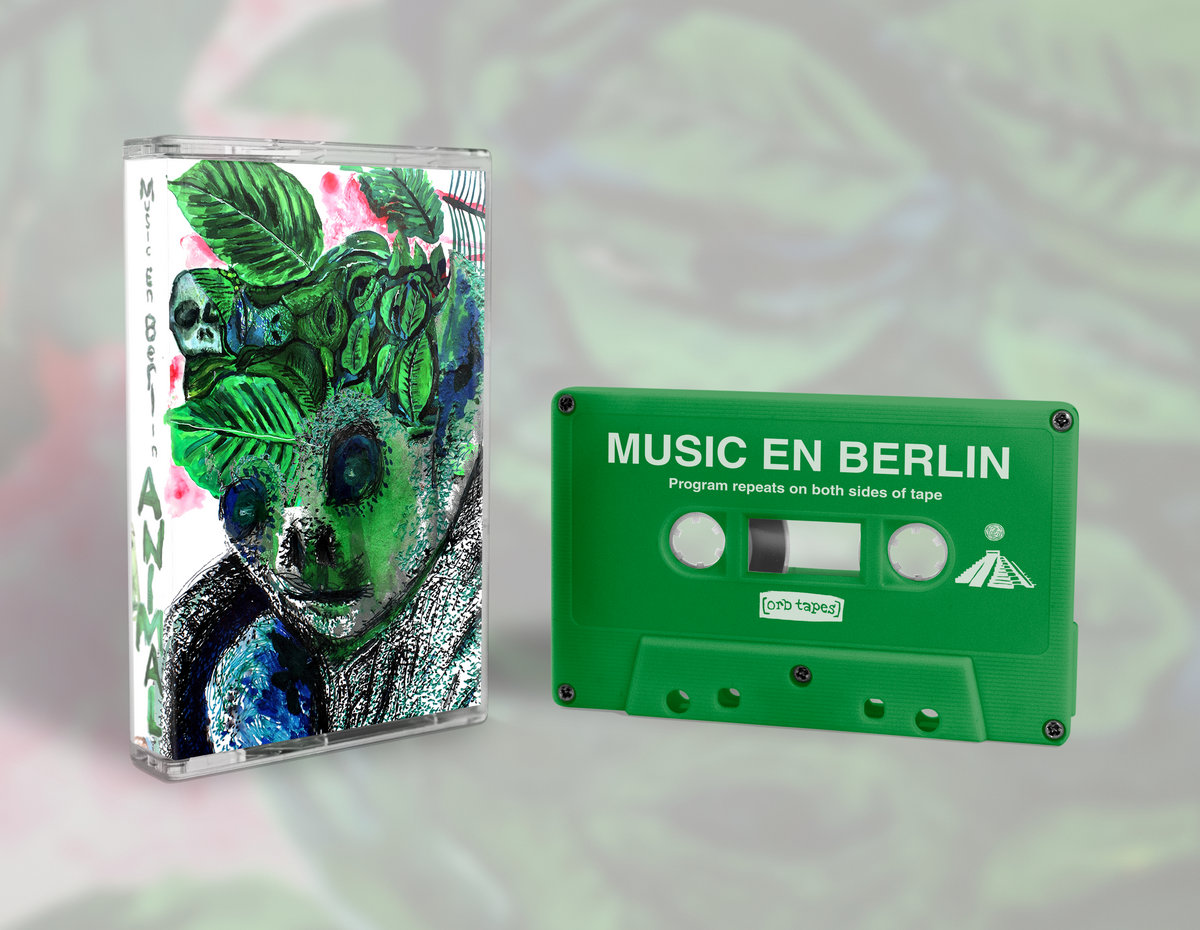
As an uncultured American swine, I had a simple desire. I wanted to understand “the music in Berlin.” However, when I whispered this into the monkey’s paw I bought off etsy, the paw reached into my pocket. It pulled out Music en Berlin’s Animal, an Orb tapes release from last year that I must’ve seemed to sleep on. Perhaps I was being too zealous, making oversights on tapes literally right under my nose!
When he’s not striking up the visuals for Daft Alliance, Nathan Berlinguette has started publishing his “new musics” under this Music en Berlin moniker. He’s been at the wild n’ crazy ass world of “end time” music for over 25 years, dating back to 5/5/2000s prophetic guitar wails. Different collaborations of all sorts of sounds have appeared in its wake, while Berlinguette’ has shared the stage with numerous names and line-ups (Ms. Pharmakon anyone?). This newfangled solo endeavor is more dream-like and unfiltered. Animal’s single-sided run time emphasizes a seven part story, with these seven tracks acting as an imagined soundtrack for his pulp slasher sonics.
It feels apt, considering that these pieces have a sense of foreboding crevices and boogeymen-esque movement. It may take a moment to find its way towards those sounds, with Scenes 1 & 2 practically opening en media res with hemorrhaging generator feedback–itself a burgeoning star making ample yet welcome appearances throughout the tape. Yet, by Scenes 3 & 4, the noise atmospherics are leveraged for dubbed-out surveillance type beats. These tracks lurch and roll, an unending uneasy paranoia. Scene 4, in particular, weaponizes that feeling of being hunted down on a submarine in lockdown when you’re the last alive. After Scene 5’s brief detente though, Nathan closes with Scene 6’s evanescent illbient, a sudden spurt of claustrophobic tension that (naturally) allows one last revving of the generator noise out for great propulsion. You’ll be deep in a comfort coma after it all concludes with the brief popcorn clatter of Scene 7’s popcorn handshake miasma.
For a single-sided adventure, it’s never so gritted it feels unapproachable. A nifty addition to the Orb Tapes tapestry.
Professionally dubbed in real-time green shells tapes, with 2-sided white pad print. Limited to 75 copies available at the Orb Tapes Bandcamp Page
8.11.22 by Matty McPherson