Rrill Bell – False Flag Rapture
8.10.22 by Matty McPherson

Rrill Bell – False Flag Rapture
8.10.22 by Matty McPherson

Tabs Out Rule 34 states that you always have to keep your ears open for a James Plotkin cassette mastering job. The guy is like novelist James Patterson–in that both can’t not stop their respective jobs (perhaps at risk of plummeting the world into peril with their demises). Anyways, it’s a good rule that always keep me from filing just any tape away, such as Rrill Bell’s False Flag Rapture. That’s the work of American expatriate/German-based musician Jim Campbell. Campbell had sorta spent a period of six year (2015-2021) trawling the mental-hertz of witnessing a sudden dormant memory spurning to life. False Flag Rapture is an interrogation of this memory–his Slovenian grandmother singing a hymn in Slovak dialect impromptly after 50+ years.
Tabs Out Rule 35 states that “if it’s electro-acoustic its probably for big dweebs.” Fortunately, False Flag Rapture is anti-dweeb electro-acoustic. In fact, it’s more musique-concrete/dream art type shenanigans, restless without tepidness. Campbell’s MO to traverse this memory, and itself the nature of his own collective family memories, is personalized into this C42; a longform split into two sides. It’s a warranted approach, because Campbell’s music is endearingly inscrutable. He refuses to distinctly spell out the memory or his own memories from within the family tree. The tape and extrapolation of this memory is the product of studying and applying various 20th century approaches to sounds into hybrid forms. The textures of his drones and sounds strike images of analog, oral-driven pasts. Places barely connected by technology and almost moving backwards in time. Less rust belt, more “rusted and dusted” belt.
It hardly comes as a surprise that this music then often slinks or twirl like a dust devil. It opens like an analogue bubblebath, complete with morse-code bleeps and quivering haptics. It sounds of an omnibus presence seeking a shape it cannot quite shake out. As it furthers through its cycle, Campbell is able to start to tease out different elements in the mix, bringing to life a situated, personalized journey to this memory. By the ten minute mark, the piece has shifted towards a low drone, emanating textures that recall radio cabinets and dust bowl power-lines. It sounds powerless though, as it moves through radiator hum textures and blisteringly empty streets, ending as a belltower strikes back and forth. If we’re to understand this memory, we must be keen to these elements and that world they occupy.
When Part 2 enters, it’s almost Pram-ian in the way looping wind chimes create a near-nautical state of hyperawareness; they sound of the majesty one finds when in perfect range of 3 tornado sirens going off at once. To follow, Campbell does provide the a recording of the lead-up to the recording of his grandmother many odd years back. It is as if all the traversing of this music concrete was to lead to this memory. Yet, he backs it out to let Alex Morsey’s tuba and Felix Fritsche’s wind instruments block the memory, with a sense of somberness. The recording does finally emerge, plain and understated, unmanipulated for maximum impact. It quickly returns to the pre-conscious dream state that has defined so much of this long form. That stretch of the final ten minutes really might just be my favorite though. A colossal low end drone, the product of various manipulations to a tuba, mends up chiming bells, and haptics that sounds of vaporous fireflies; it flows in lockstep, safeguarding the memory for another go around on the hi-fi.
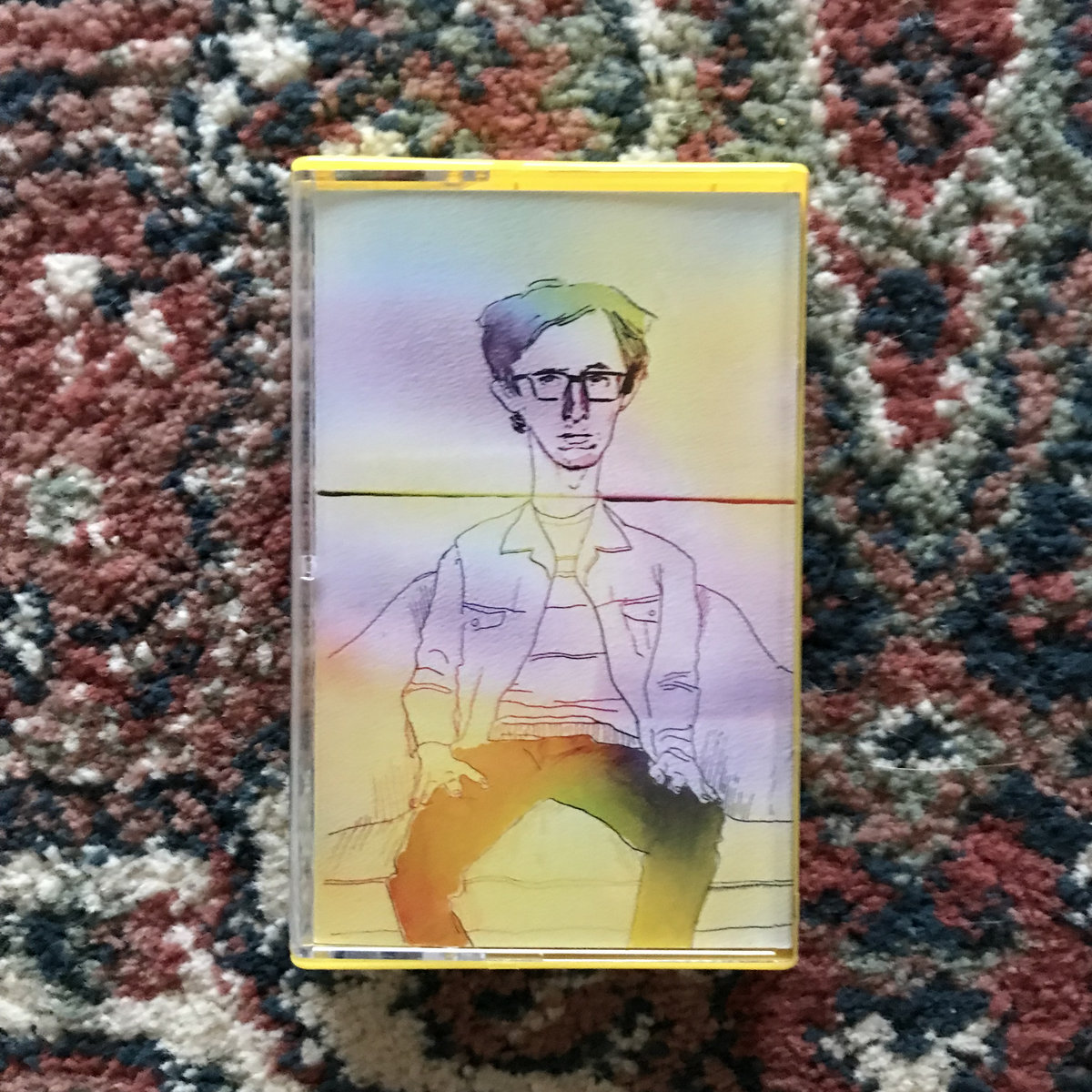
Edition of 100 42-minute lime green cassettes (with full-color six-panel Jcard in clear Norelco case, plus full-color outer Ocard featuring collage art) available at the Rrill Bell/Elevator Bath Bandcamp page.
8.5.22 by Matty McPherson

Just what incubates such tenacious sounds? Is it amps and pedals amongst other equipment? Location that brings such disparate voices togetheres? Our pained times that incites it all? I’ve recently had a recurring daydream of Drone festivals. One as a liturgical mending that extrapolate feelings outside the present moments, as much as they document the situation they find themselves in. Amirtha Kidambi and Luke Stewart would both be there together in that daydream. Both have strenuous, muscular range in their approaches to sound conduction. Kidambi’s voice and electronic effects grant it an elasticity; a painted echo of the past or a panopticonic prelude to the future. Stewart’s bass and amplifier feedback prowess has often led to states of post-zen bliss and punk’d noise experiments. They’re both industrious thinkers. Although I can’t comprehend a time I’ve heard either of them as hellacious and studious as on Zenith/Nadir, their open-book drone improvisation for Tripticks Tapes.
Zenith/Nadir has been simmering and stewing since an August 2020 meeting between two at Pioneer Works. “A time where despair and possibility were inextricable,” the Bandcamp summary contextualizes. For the two esteemed improvisers, show-bookers, and ontological new music scribes, it’s a chance to take their complementary approaches in search of blistering territories unknown. Their seven seances are harrowing, improvisations on the brink of being swallowed by the earth whole or thrown to the stratosphere. Both sides favor aversive, yet not opposing or diametric approaches.
The transient opener “Circulation” is practically degrading en media res as Kidambi applies ample effects to her voice. One layer of her voice stands as a mantra-esque drone, while another is jolted and modulated into an epigraph of tumultuous walkie-talkie noise. Meanwhile, Stewart’s engineering and approach to feedback steadies the two dissonant sounds; through cracky tonal static until it finally reaches a low hanging orbit of clarity. “Premonition” is toying with similar effects, although with Stewart’s bass more noticeably beefing out the low-end. “Postmonition” concludes this trio, seeing Kidambi’s voice so beyond-process that it has shapeshifted into a horn instrument crescendoing and bellowing into a bonafide WAIL of a thousand suns. Side A’s closer, the eleven minute “Exaltation,” scales down the noise for more emphasis on the two’s distinct instruments. Kidambi is able to lull us into the industrial lullaby. Even still, the duo continually shift the dimensions of the recording with just a few quivers of Kidambi’s voice or the occasional strum of an upright bass. You can’t quite tell whether this was recorded at Pioneer Works, in a destitute cavern, or at some Port Authority blacksite.
Side B relays the focus into thousand-yard stare acoustic duets, amounting newfangled folk nadirs from the two’s traditions. “Relics,” “Medium,” and “Telepathy” are closer in kinship to ka baird’s Voice Games than an Orb Tapes release. Yet, for Kidambi and Stewart, there is nothing inquisitively gamey about this (even as these tracks are wildly fun). In all three of them, the duo try to keep pace with each other’s freewheeling sleights. I love about a third of the way through “Medium” how Kidambi mends her voice into a machination so suddenly that Stewart is having to drop restraint and move with whimsy, in lieu of brevity. Instead of relying on feedback or suddenness, the closer “Telepathy” sees the duo opt to slow their manner of operation. They draw out notes within their respective instruments. The sonic space is smaller, as if to let the acoustics of this space breathe. There’s a somber aura of near-silence to the piece. It stretches and contortions, a reflection on the zeniths it found itself tangled within just half an hour before.
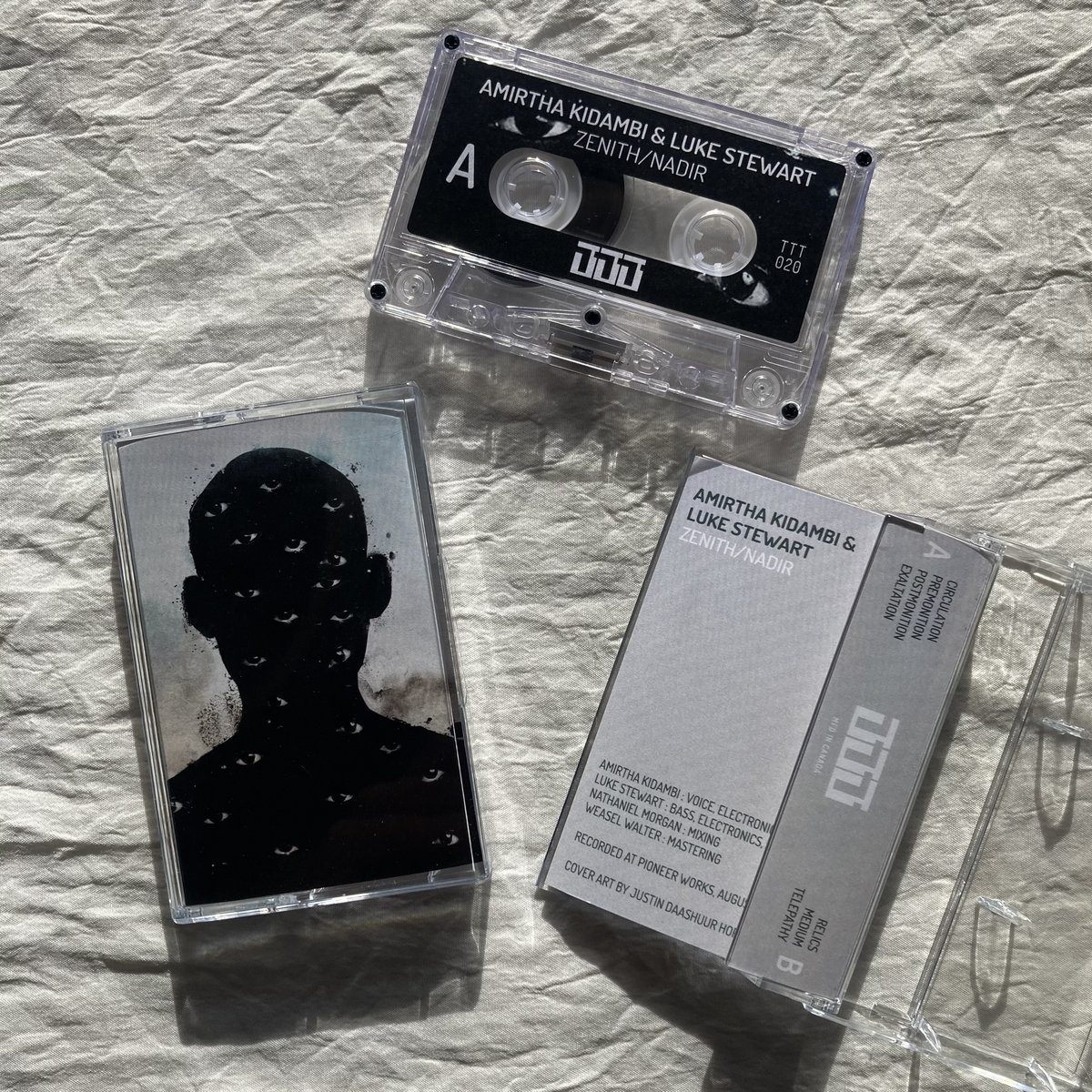
Edition of 100 tapes in clear transparent shell with white hubs, pro dubbed and printed available at the Tripticks Tapes Bandcamp
8.3.22 by Jacob DeRaadt