12.6.21 by Matty McPherson
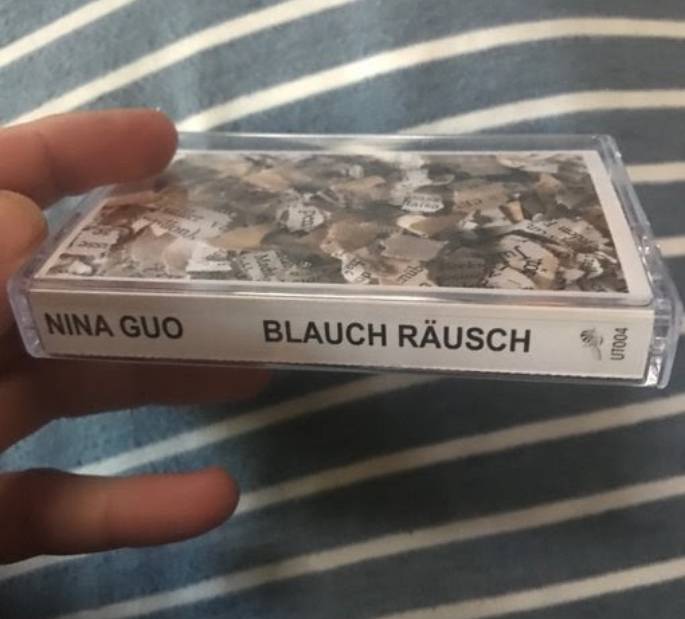
As soon as I plopped the half-listened side B of Blauch Rausch into the player, I felt that sublime feeling–the one that teeters the line between “this really the pinnacle of what ferric tape has to offer” and “wow this is insanely rudimentary vocal argle bargle.” It’s a magical feeling because if the chips stay on the table and the bet pays off, then I likely have myself a tape I’ll be gloating over. It is with a light heart that I can confirm Nina Guo is leaps and bounds a genuine talent. The Berlin based Guo’s debut, Blauch Räusch, on the burgeoning Unknown Tapes imprint is one of the more colloquial and startling tapes I’ve heard across 2021. The sound of someone letting loose and going hog wild in the good way. It left me with a litany of questions and unspeakable, uncategorized quips that I suppose I’ll be left scraping for an answer to with no avail.
One question I know I want to ask is just how much funding do libraries have for onomatopoeia story hour? And if they do have funding, then why isn’t Nina Guo being tapped for a world tour of library reading rooms for her semantics and antics? Blauch Räusch is a heavy piece of vocal games that would absolutely floor a group of kids as much as it might give their parents who use a library to check out classic orchestra CDs a run for their money.
Most of the pieces are really not that long here and they recall David Moscovich’s Dada Centennials for Tymbal Tapes or Ka Baird’s own Vocal Games; both utilized a lack of formal cohesion to answer and pose quandaries that stock instrumentation just could not provide. Guo follows suit, with a (literal) page ripping level of dada to these compositions. After being ushered and shushed into the “listening commons”, the laugh riot “25” throws us for a loop. Meanwhile, a piece like “Bud Burst” sees Guo turning her voice into a bonafide modular synth–a mini orchestra that sputters and spits until it arrives at a terminal impasse; it’s only a minute but good god is that an exciting minute. “detest” builds up a crescendo style flow that is clearly arching for that opening spot at a 75 Dollar Bill show. After the laugh riot of 25 comes the stoner babbling in tongues/burst spray frenzy of “26!” It came as a surprise, especially after being told 24 is the highest number.
Side B is ruled by one of the year’s best singles/longforms/grant applications for library programming, “aristocats”. And yes, this is a full-blown re-enactment/synopsis/borderline-zonked out performance of the 1972 Disney film, the Aristocats. Complete with a full rogue’s gallery of voices, plenty of mumbles and tumbles, and some fantastically laugh off loud quips about the film’s not-so-subtle racism, the sheer majesty of this execution had me salivating. I could only imagine how Guo would throw her arms around or run up and down…like I say this is a wildly imaginative kind of tape. Hell, it even ends with three minutes of screaming like a door creaking and creaking like a door screaming that gives any Hallmark Halloween tape a run for its money.
First run of 50 copies only available at the Unknown Tapes Bandcamp!
Related