Tabs Out | Tim Thornton (4) – Teenage Tiger: Four Track Recordings 1997-2000

Tim Thornton (4) – Teenage Tiger: Four Track Recordings 1997-2000

5.31.22 by Matty McPherson
I feel as if I’ve been on a weird time travel odyssey the last while here. I can’t quite explain it, but just know the music seems to be a sort of variable at play here. I think this happens to us as a species more often than we know to articulate.

Anyways, we turn our attention to Mr. Tim Thornton (4), the local at the vinyl plant as well as the caretaker of Suite 309. When I’m on the local street corner or online formus slinging tapes, I’m always YAPPIN to people that they “have to get 101 Notes on Jazz; it’s so good!” Truth is, Thornton’s Suite 309 is an institution. In between Tim’s own releases (Tiger Village, TItanic II, various samplepedias) is offering one helluva platform for “electronic that goes hard” in various formats. In 2021 we got Silver Soul and Headache Bait, two releases with which words genuinely escape me in expressing the MAGNITUDE of what these pros are doing. To Sophiaaaahjkl;890 and hyphyskazerbox, your tapes are personal triumphs; I deeply love those undersung releases.

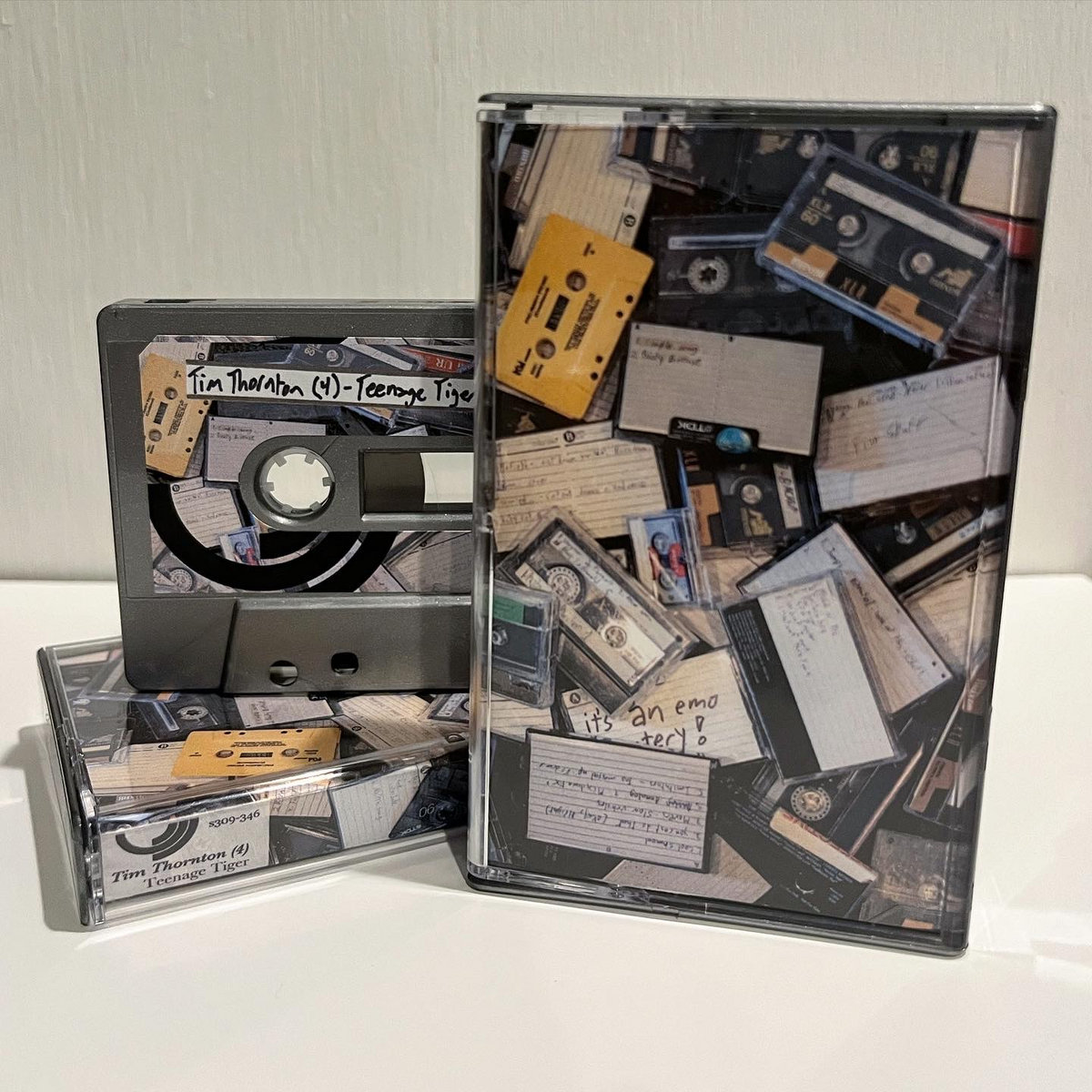
Today’s focus though is not on a return to 2021, but a return to the end of the millennium. Teenage Tiger: Four Track Recordings 1997-2000 is quite the welcoming and heartwarming release from Thornton; a genesis that lays out everything on the table. Tapes don’t just come with that Jcard presenting a fat stack of 4-track tapes and whatnot; we got a fatstack of liner notes and personal observations from Tim himself! And if there’s one thing that can be expected about those notes, it is that they are damn precise. You will likely learn: where and how Tim acquired a Fostex XR-5, what year he heard Aphex Twin, how he went to Florida, and what DVDs he liked in the year 2000. This is all important stuff for the Tabs Out 2027 Trivia Showdown, so PAY ATTENTION!

I have a huge heart for these kinds of rudimentary experiments–there’s an energy and ethos of exploration that works its way through Tim’s recordings even to the present day. By 1999 he was mostly using a “fostex xr-5 four track, boss ddr-660 drum machine, dod dfx91 delay/sampler, digitech rp3 pedalboard, toy keyboards, and rock instruments” to just fuck around with and make his own odysseys. By 2000, it was a strategy that was procuring Meen Man, a piece of samplepedia crossed with hogwashy drum n’ bass and (basically) 4-bit 240p action sounds. The sound of an MTV summer crossed with a potent amount of Code Red. Of course, most of Tim’s material here doesn’t reflect 2000. The endearingly haphazard Tires (1998) skirts and tumbles without a proper dance attached to it. It is one of many tracks perpetually on the fritz. 

In a way, I’m reminded of Bellectronic, the fascinating Techno footnote STR unearthed last year, mostly because both tapes are the products of one person engaging with a facet of mass culture in their own private way. With Tim’s recordings though, you sense someone who keeps finding NEW things as a teenager to fuck around with; songs are journals and timecapsules. He buys a matrix DVD and starts playing with his favorite quotes. He needs to submit something for the band teacher and basically puts a couple of ideas in a blender just to fuck with the fella (Audition Tape (1997)). He takes apart Elevators and basically makes a piece of illbient, DJ Braille (2000), that could’ve accidentally been slotted next to Techno Animal. It doesn’t matter that any of this is beginner’s luck. I’m just genuinely moved by the fact that with a nascent internet, Tim was just honing in on his own processes and modes in a way that felt more regional, landlocked, and curious. If there was a generational ancillary to Tim Thornton, it might have been one of those youtube MLG poopsters from the early to mid-2010s. Sometimes Four Track Recordings radiates THAT kind of magic energy I miss so dearly.

What is undeniably lingering over a lot of this release in some way is Richard D. James. One day, Tim is greeted by The Aphex Twin on the TV and hears a stereophonic drum sound he wants to troll with, affording him a track that’s basically just PS1 boss music, W (1998). From here on out you can basically run a calculation to figure out how much Aphex he could afford to buy or acquire sans import prices and what he really wanted to ape or gouge from. I seriously had thought part of Siol (1999) was egging Isopropanol’s Roland synthesizers, until Tim revealed his usage of the Rebirth RB-338 Roland emulator. God, what an open and welcoming trickster.

Edition of 60 home-dubbed tapes with silver shells and silver backed norelco cases available at the Suite 309 Bandcamp Page
Tabs Out | Sound Holes 94 – 96

Sound Holes 94-96

5.25.22 by Peter Woods

The font used by Sound Holes, a diverse tape label based out of Scotland, produces a pretty intense blast of nostalgia for me every time I see it. The straight forward sans serif letters that have been chewed away at the edges, as if the typewriter that imprinted words on each and every j-card had seen better days, feel as if they came straight out of an edgy 90s advertisement. If someone on a skateboard with a backwards hat and sunglasses chucked this tape at my dome while shouting “this ain’t your grandma’s noise tape” before cruising off, the font would fit the profile.

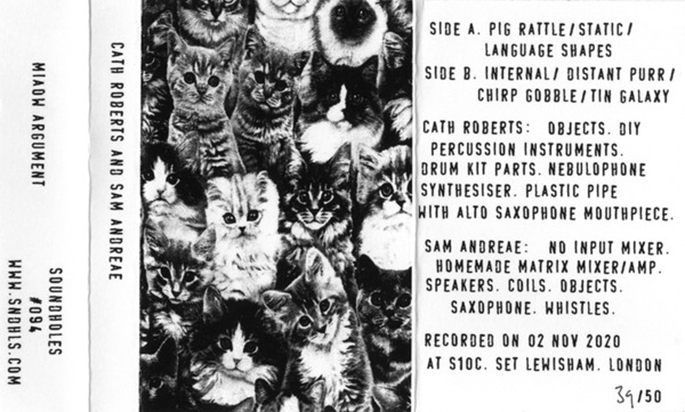
Thankfully, the kitschy 30 year throwback seems to exist completely in my head. Or at least it does for three recent tapes released by the label, all of which tie directly into different facets of the current experimental music landscape (and not a 90s aesthetic landscape created by an advertising agency). Cath Roberts and Sam Andreae, for instance, draw from contemporary approaches to free improvisation on Miadw Argument. Between Roberts’ mostly acoustic objects and Andreae’s electronics (alongside a smattering of saxophones and whistles), the duo creates a sense of intimacy through their embrace of space and confident playing. By allowing the instruments to speak for themselves without feeling any need to hide behind layers of sound, the group creates the feeling of pressing your ear against a tiny speaker or resting your head on a table next to a small acoustic device while sitting shoulder to shoulder with the performers. Or maybe it’s the feeling of being shrunk down to the size of a bug, meandering through an array of buzzing, whirring, and glitching objects with only the occasional moment of a giant human interfering with this technological playground. While holding to this approach may be stifling for some, the duo covers a lot of ground across these recordings, holding your attention without any real lulls throughout.

In an almost mirror opposite approach, Brandstifter and Diurnal Burdens bring expansive and dense soundscapes on Fünfte Symphonie. Proving similarly diverse, the duo dives deep into the best aspects of tape music with a pacing that never moves past “lurching.” Fluttering warbles, offset loops, and that gorgeous hiss all meld with scrapes and clanks from what I feel like has to be live recorded scrap metal or industrial field recordings. Separating or locating the individual elements becomes nearly impossible without ever falling too deep into the murk or mush that tape music often produces: certain sounds feel like they have to be a tape loop until you realize none of the sounds repeat and vice versa, that sort of thing. An affect of longing then emerges from the collection of musical components, creating the sense of a hazy memory floating just past the grasp of the listener but never fully materializing. Like you should remember exactly where all of this came from but, on further inspection, realizing that it never actually happened.

Reconnecting with a sense of space, Camila Nebbia turns in an equally powerful and confident performance on Presencias. Foregrounding her saxophone playing throughout, Nebbia seamlessly shifts between technical skronk and wispy extended technique, as if translating the gesture of a radio moving in and out of a tunnel to an acoustic instrument. Nebbia then connects these outbursts of highly skilled playing with distant feeling texts and field recordings, producing a distinct sense of space and context. While a close recording of the saxophone performance without the additional sonics (released as, dare I say it, a CD or digital download) may provide a clearer and more detailed document, the inclusion of the field recordings produces a feeling of transportation. This music, taken together, feels like it had to have happened in a particular space rather than existing as an album you can listen to anywhere. Thankfully, Presencias brings you into that space, creating a feeling of listening from within instead of witnessing from the outskirts.

Although none of these tapes rewrite the scripts of the genre niches they work within, it doesn’t feel like this music has to do that or that the artists were trying to break the mold in the first place. The three albums reviewed here powerfully reassert the best aspects of their respective musical forms and radiate the confidence needed to be exactly that. These tapes are workhorses, contributing to the foundation of the current musical landscape without trying to grab unearned attention with flash or gimmicks. To this end, the Sound Holes font actually makes a lot of sense: a straight ahead sans serif font that comes from a well worn but trusted typewriter actually provides a pretty apt metaphor for every one of these tapes. By going back to basics without feeling redundant or derivative, these tapes feel instantly familiar but encourage multiple listens. Even if an energy drink chugging skateboarder didn’t grip them 3 feet above a flaming half pipe.

Tabs Out | Euphoria Echoes of Inotai – self-titled

Euphoria Echoes of Inotai – self-titled

5.23.22 by Matty McPherson

We don’t hear from Baba Vanga (or Warm Winters Ltd) that often out in the Eastern sphere of the European landmass. It’s likely not because they can’t afford to talk, but because they only talk when of utmost importance–when at least in Baba Vanga’s case, things “catch their fancy.” Or maybe they actually do talk a whole lot and me, being a dipshit westerner, just completely ignores their message bottles (ie “cassettes”) until months later.

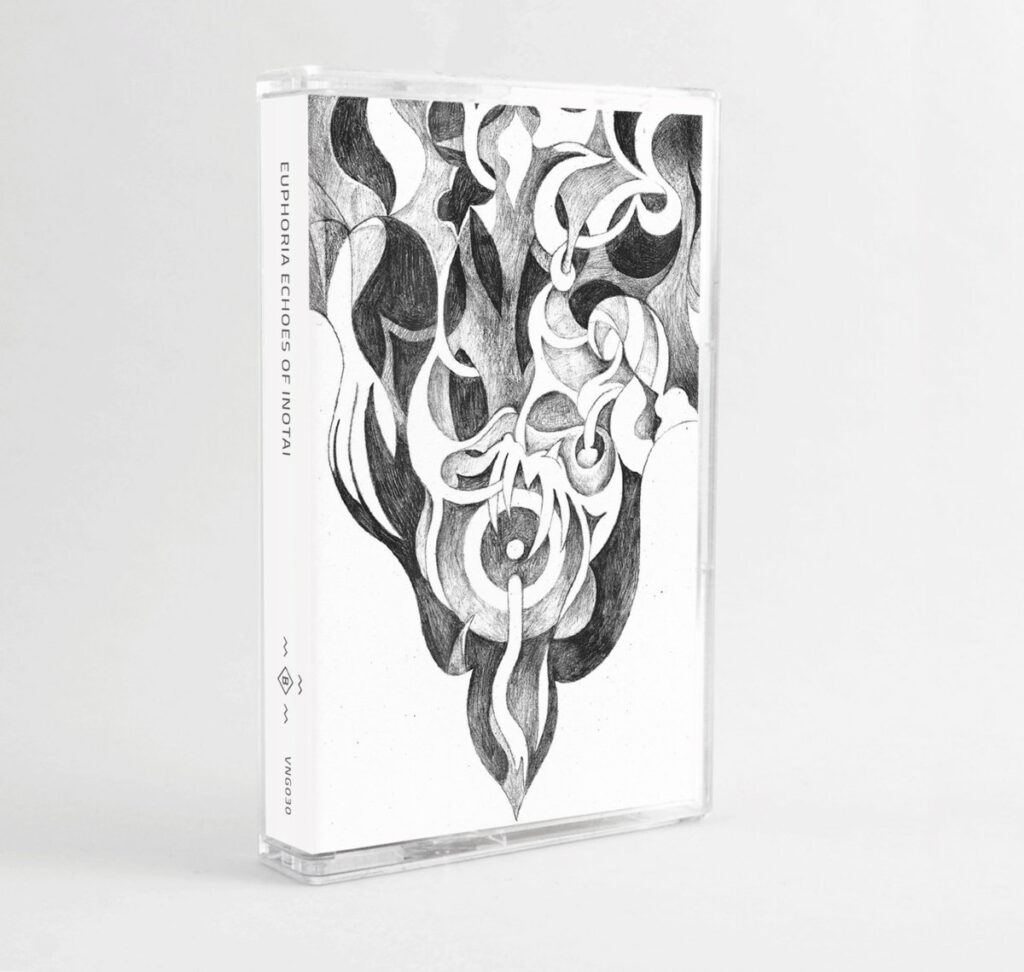
And what a message bottle they returned with back in November 2021. The self-titled release from Euphoria Echoes of Inotai comes with a surreal yet lucid piece of Bandcamp prose attached on its page. Of all the lines, “Path of no distinction for wind blowing mind, don’t call it music if that word offends you.” is the one that strikes the hardest. Because Euphoria Echoes of Inotai (aka…Meat Loefah?) is really out here on this tape performing an urban wind dance of its own volition.

The tape is entrenched in a weird balance of vague industrial noise. There’s haptic quips invoking minimal bouts of street spirit; classic radiator hums of destinations unknown and unbuilt; low-end near blowouts, evoking that of a sudden floodgate rush. All together deserve of its own subsection of semiotics. Tracks truly function in their own asynchronous shuffle patterns or psychedelic city backends. Transient and stilted, stuttering into each other or off of one micro-experiment pipe to another; once an idea has coalesced or achieved all it can, it sorta just bows out, the tape continuing down another spark of an idea.

It’s a testament that it does make for a gripping kind of listen. The artist title implies Euphoria and while it is not so much found, it is slowly gained by considering the patterns and lucid, almost prophetic, soundscapes that you are lulled into almost understanding. This is all to say that what I deeply love about this tape is the uncanny “radiophonic but also just totally untethered by it all” sound of this batch of a dozen electronic tracks. The rough n’ tumble of side A is a world of its own and approaches a moment of almost-dance with the track “Pump Up the Valium (Poetic Logic Mix)”. It’s a rare moment where enough elements coalesce into a real vibe caught between an arcade room quarter bandit splurge session and ambient synth chill out; so much for the valium.

Side B is more graciously grounded in the knob twiddlies–well, at least in the case of opener Damion Engine. By the followup, Absence Spells, we’re back in rousian haptics and vocal affects, itself brilliantly segueing into the “Ritual of Rhiannon.” In the context of the tape, its unvarnished vocal and “creaky yet cavernous” production create a spell that practically transports you to a village from an era long before. Scooby Doo People reengages with the twiddlng and introduced a “radio teleplay gone awry” filling the air. That side B is also edited into a seamless whole plays to the advantage. Fade outs are rarely utilized, with a clear preference towards the crossfade that makes bouncing and connecting ideas of this caliber salient. Closing once agaIn with “Pump Up the Valium”–this time the (Poise Mix), we’re treated to a complete 180 from where we were before. Harmonious strings promise an out, while gelatinous noise blobs conjure a loop back to the start. It’s no surprise I’ve been clearly been taking to those noise blobs.

Limited Edition Duplicated by Headless Duplicated Tapes in Prague, Czech Republic available at the Baba Vanga Bandcamp