Tabs Out | Women of the Pore – Folk Music

Women of the Pore – Folk Music

3.3.20 by Ryan Masteller
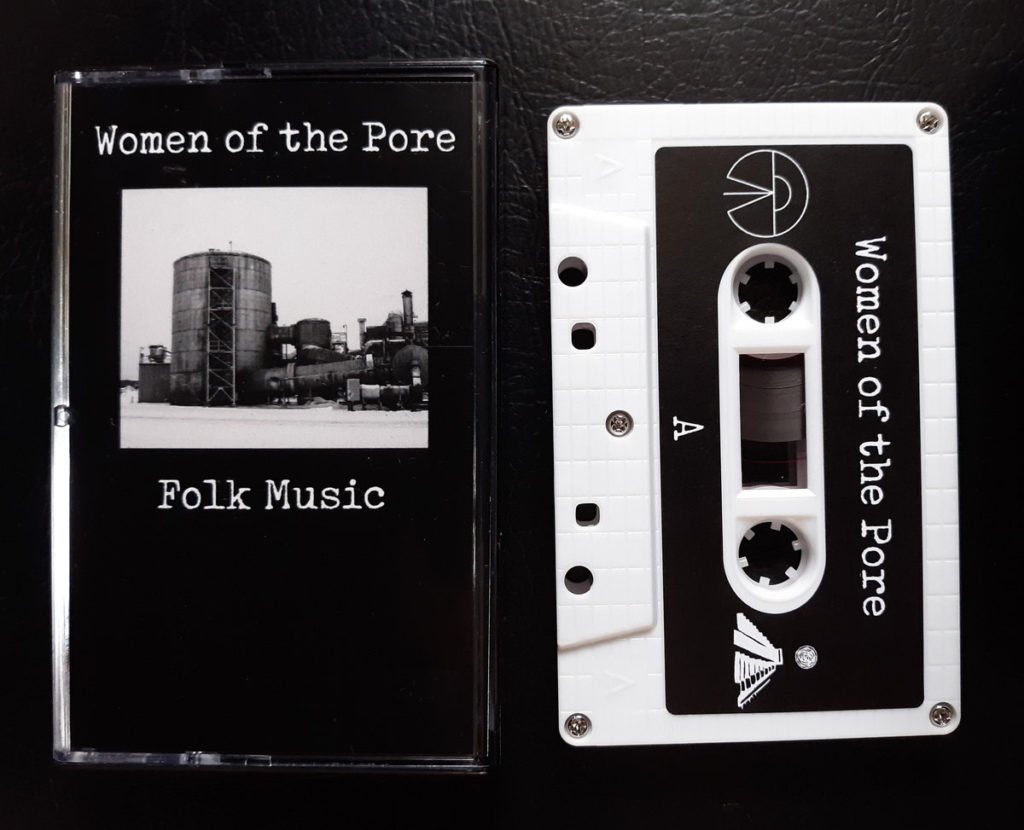
What the heck IS “bunker jazz,” anyway? I honestly don’t know. The internet wants me to listen to something called the Bunker Jazz Band, but that isn’t it – I want to listen to Women of the Pore, the New Brunswick troublemakers responsible for things like “Don’t Let Them Bastards Grind You Down” and “Dump Babies.” For me to sit here and try to define the undefinable, the conceptually slippery, the culmination of random words slammed together for the heck of it would be futile. Just think about what a bunker is. Then barely apply jazz to it. Like German Army, maybe, but without the samples or the industrial clanging.

There’s some industrial clanging.

Furthermore, don’t be fooled by the title, because this isn’t Woody Guthrie or Bob Dylan or Creed and Fred Durst holed up with an acoustic guitar and a tape recorder. This is instead the basest of the base, the lowest of the low, the subterraneanest of the subterranean, music made on an earthen floor of some room cut into the living crust of the earth itself. A “bunker” perhaps? Sure, let’s get crazy with this. From here the Women ride plodding low-end rhythm, cutting it with blasts of synthesizer and brass and other such oddities and noise-ities that you couldn’t pin down even if you were the music teacher at my high school (who was pretty good). Content with their crapulence, Women of the Pore play music for crouchers, for crawlers, for stumblers who just can’t gain a foothold in this modern excuse for society. These listeners are the downtrodden, the forgotten, the tossed-aside – they need somebody to speak for them.

Wait – maybe this IS folk music, like ol’ Woody imagined all along. Machines killing fascists and whatnot.

Still, this mirror to the basement level is like a psionic punch to the gut as you wallow along with Women of the Pore. The specter of endless toil follows you throughout the tape, and the existential dread builds until it’s almost unbearable. But that’s what makes “Folk Music” such a riveting listen – it doubles down on the environment and mood and never breaks character. You’re left to your own devices in the middle of it, and I’m pretty sure you won’t get up to much except for trouble. Let “Folk Music” be your evil guide.

These grody pro-dubbed cassettes are limited to fifty copies from Orb Tapes.

Related Links
Tabs Out | Euglossine – Psaronius

Euglossine – Psaronius

3.2.20 by Ryan Masteller

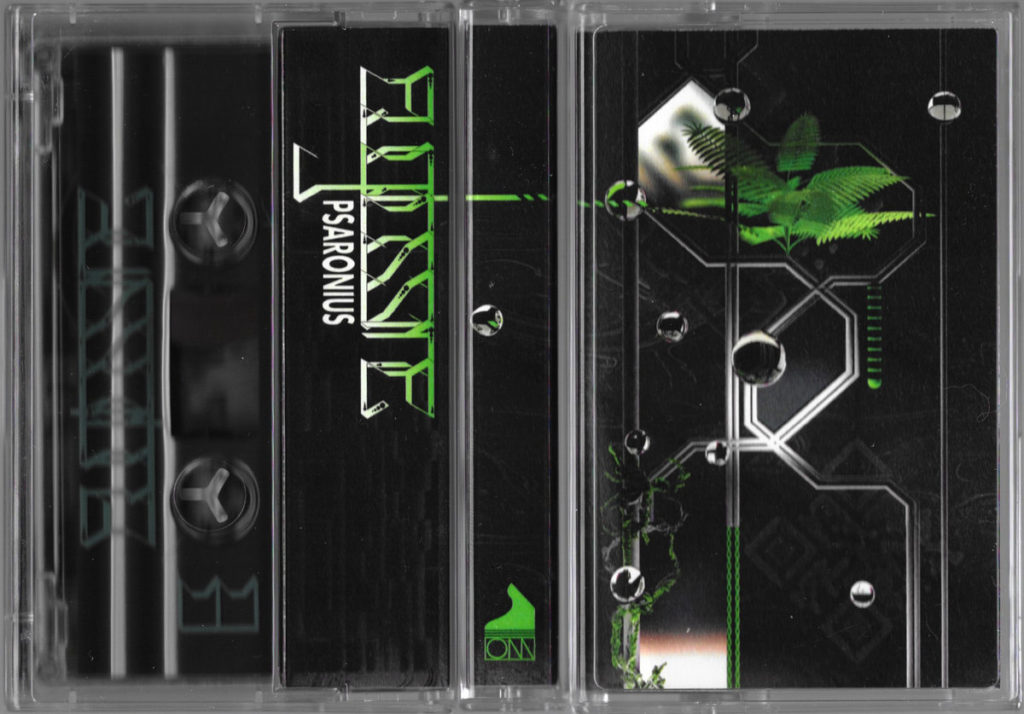
Fusion does not progress any further without Tristan Whitehill. I mean that universally: as a genre, as an act, and in general – literally, Tristan is at the bleeding edge of his discipline. As Euglossine, he continually pushes the boundaries of concept, synthesis, and composition, settling somewhere between a guitar and an electronic savant, which is, like, the goal of a lot of aspiring musicians. I myself floundered in the noise game feeding back a guitar through a practice amp before slumming it as an indie rock loser. I was like a monkey with a rock compared to Euglossine and his advanced technique. (Although as a monkey I WOULD have opposable digits on my feet and a prehensile tail … I’d like to see old Tristan try to peel a banana with his feet while hanging from a tree!)

Speaking of trees (in a roundabout way), “Psaronius” refers to the petrified stems of an extinct fern, its etymology “stemming” (get it?) from the Greek word meaning “precious stone,” because the petrified leaves were fashioned into ornaments worn by people. (Thanks Wikipedia and Keith Rankin.) You ready for some high concept? Euglossine examines the relationship between the patterns found in these leaves and in these ornaments, their natural constructs, and compares them with digital patterns found today, such as those in QR codes. Turns out our world organizes itself in similar ways, across time and discipline, regardless of whether the pattern is natural or synthetic. That’s some neat stuff!

Tristan therefore has composed “Psaronius” to reflect the relationships between the natural and synthetic, the similarities inherent in basic structural forms, using the Psaronius concept as a jumping-off point. Sounding at once both digital and acoustic, “Psaronius” blurs the line between programming and performing, pitting one against the other while combining them, just to see if you notice. Indeed, Tristan has utilized “wooden flutes, log drums, 5 string bass, sequenced fm synthesis, iOS apps, and a vintage guitar synthesizer” to realize his experiments, and the result is nothing less than the most futuristic fusion imaginable. Imagine being placed in the middle of a fully functioning terrarium superintended by green robots whose sole purpose is to maximize sustainable technology to cultivate agriculture that can be used by everyone, everywhere – waste not, want not, forever! It’s like a World’s Fair exhibit come to life, for real, with “Psaronius” as its perfect soundtrack. 

I’d eat those beans!

Check out “Nightflowers at the Beach of Oblivion,” then head on over to Orange Milk and grab a copy of “Psaronius.” Like, why wouldn’t you?

Related Links

New Batch – Unifactor

New Batch – Unifactor

2.28.20 by Ryan Masteller

Hilariously, or maybe not so hilariously, depending on your threshold for humor, I found out the hard way that Unifactor label maestro Jayson Gerycz was the drummer for a Popular Band. The incident occurred when said Popular Band hit a joint close to my hometown, and Jayson kindly asked if wanted to check it out. I politely declined, because I’m old and often tired. Then I asked what band he was in. It was a Popular Band! I felt so sheepish. Because of that deep level of embarrassment*, I will be quite careful to not make the mistake again. All artists below are now given due credit.

*We had a good chuckle.


{ARSONIST} – REALITY STRUCTURE

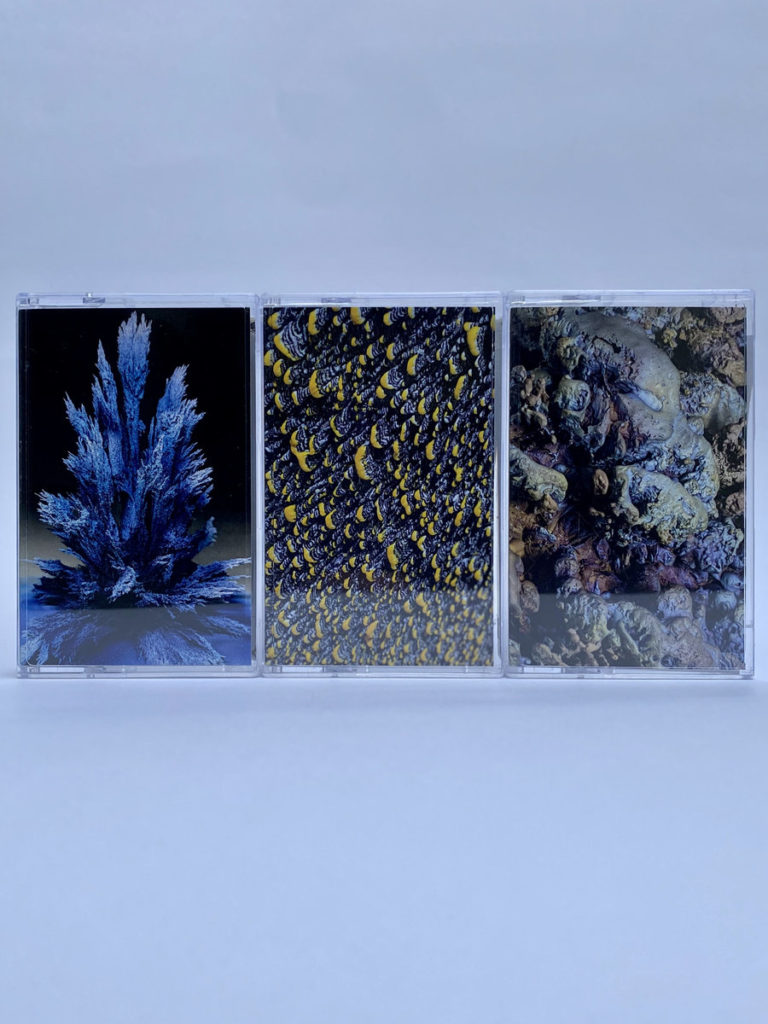
{arsonist}, aka Flea from Red Hot Chili Peppers*, brings a sense of mystery and awe to “Reality Structure,” a keyboard/synth-driven delight that flourishes in grand quietude while mutating and expanding and contracting and staying still, all at once. Take a look at that cover image – really look at it, let it sink in, allow it to fill your mind. Now, think about what it is and what it sounds like. Is it a frigid explosion, like a nitrogen cryogeyeser on the surface of Triton, frozen in time? Is it a water ice crystal forming oddly, springing against gravity from a chilled surface? Or is it a coniferous tree in the middle of night, covered in frost? All of the above are assumptions that hint at the sounds contained within, a reverent glistening monochromatic aurora of soundwaves, an effect both glorious and nostalgic. It kind of reminds me of Event Cloak a little bit. In fact, this could easily be an ambient entry in the Orange Milk catalog. But it’s here, in Unifactor’s, where it dang belongs. 

*For legal purposes, an asterisked caveat such as this one must accompany the joke.


MOTH COCK – MYSTICS AND STATISTICS

Pat Modugno (trumpet) and Doug Gent (saxophone) take a break from their main gig in the Doobie Brothers* for a new Moth Cock tape, “Mystics and Statistics.” Side A Is “Mystics,” side B is “Statistics,” get it? No one who goes around calling themselves “Moth Cock” is going to, ahem, dick around by coming up with separate names for everything. Moth Cock gets right to the point, and with “Mystics,” the duo not only gets right to the point, they basically play their horns like the definition of the titular word sounds. Here, the internet can help us do the heavy lifting  (go down to the noun). Modugno and Gent drone mysteriously through a fog of effects, meditating on the intense truth about the universe and junk that they’re about to reveal to us all. Truly, we are indebted to Moth Cock for the secrets of reality, just glimmering beyond the veil of the mist in the middle of this forest in the dead of night, that will surely come into focus in due time. Meanwhile, try “Statistics” on the B-side: it’s bleepier and bloopier, at least at the outset, and sounds more like an Excel spreadsheet – which, I hear, if you mic properly, comes off as the HNW program of the Microsoft Office suite. Great set!

*For legal purposes, an asterisked caveat such as this one must accompany the joke.


HOUSE PANTHER DIADEM ENSEMBLE – FIVE QUESTIONS

As LL Cool J’s live band*, House Panther Diadem Ensemble surely knows their way around a groove. But here on “Five Questions,” The trio of John Elliott (synth), Jayson Gerycz (singing bowls), and Isabelle Rew (Bomberde, a double-reeded instrument that I just heard of for the first time just now) move in a more transcendental direction, the ambience of their combined instruments serving as a guided tour along the astral plane. This is appropriate: why would you be asking any question, let alone five of them, without a contemplative soundtrack? On “Five Questions,” the players reach out into the unknown and pepper it with that exact amount of query-tude, meditating, letting both the questions themselves and the answers settle on their psyches in the calm expanse of eternity. (Notably, there’s “A Question about Time.”) We are on this journey with them, and the mysteries of life float down and alight upon us like those glowing tree sprites in James Cameron’s blockbuster “Avatar” franchise. Now THERE’S some philosophy you can sink your teeth into! 

*For legal purposes, an asterisked caveat such as this one must accompany the joke.


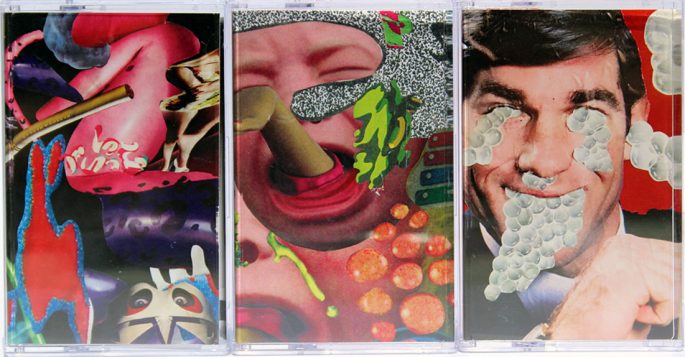
Brilliant art by Matthew Gallagher for this batch, by the way.

Related Links