Tabs Out | J. Hamilton Isaacs – Tolerance Clock

J. Hamilton Isaacs – Tolerance Clock

2.19.19 by Tony Lien
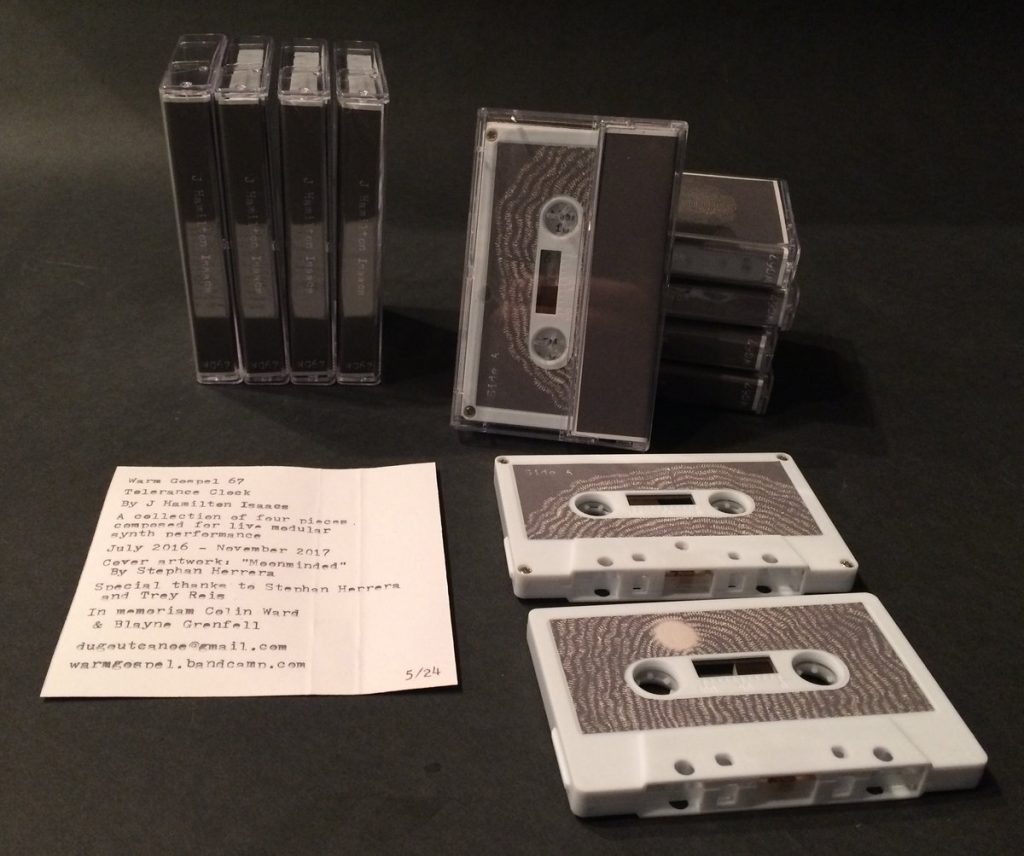
Modular compositions built with complex melody in mind are increasingly rare in the experimental electronic world — being that not only is it tempting to just let lawless noise rule the day, but it’s often incredibly difficult to create patches that cooperate on a melodic level. I do not own a modular system myself, so I’m purely basing this off of what I’ve read and what I’ve been told by modular enthusiasts.

Regardless of whether or not you believe this sentiment to be true, the modular music of J. Hamilton Isaacs’ “Tolerance Clock” (available on cassette via Iowa experimental label Warm Gospel) is something to be admired.

Honestly, I think this may be my favorite modular album to date.

The songs build upon themselves from nothing, layer upon layer of arpeggiated bleeps and bloops fitting together in a Tetris-like fashion that almost seems visible if you close your eyes when listening. Interestingly, chopped-up vocal samples occasionally replace more typical modular sounds and lead the compositions into that very particular ‘post-Internet’ territory often championed by Orange Milk Records (see track 3 — especially the last couple of minutes).

Not only do the songs work together to form an almost audiobook-worthy narrative of sorts, but the transitions from section to section within each track create a story-like experience that very much demands the listener’s complete and undivided attention. Such albums that make a person consciously aware of the full effect being lost or disrespected due to a half-hearted listen are pure audio gold — in my humble opinion.

That being said, the amount of work that likely went into these compositions is both dizzying and inspiring — especially considering that these tracks were (I believe) all recorded live. Someday, I plan on venturing into the world of modular. I can only hope to produce something half as hypnotizing and, simply put, cool.
Tabs Out | Proud/Father – Symbolic Exchange and Emptiness

Proud/Father – Symbolic Exchange and Emptiness

2.14.19 by Tony Lien

Simply put, there’s a staggering amount of ambient/soundscape/drone albums out there — and an unfortunate number of them just aren’t worth listening to. It’s a genre that can easily be exploited by the lazy or the uninspired — due to both the ease at which the music can be made and the generally low cost involved in its production. I’ve said it before, and I’m saying it again now. I’ll probably even say it a couple more times in the not too distant future.

Now that I’ve gotten that out of the way, let’s discuss what makes the good ambient/soundscape/drone albums worth our time — as listeners.

When it comes to this (sometimes challenging) genre, I feel that a story (or at the very least, a theme) is essential to the creation of a compelling album. What would Brian Eno’s “Ambient 1: Music For Airports” be without the inherent imagery of stagnant terminals, buzzing fluorescent lights and weary travelers’ faces? Just this little bit of extra effort — outside of the music itself — can do wonders for album’s overall effectiveness and emotional impact.

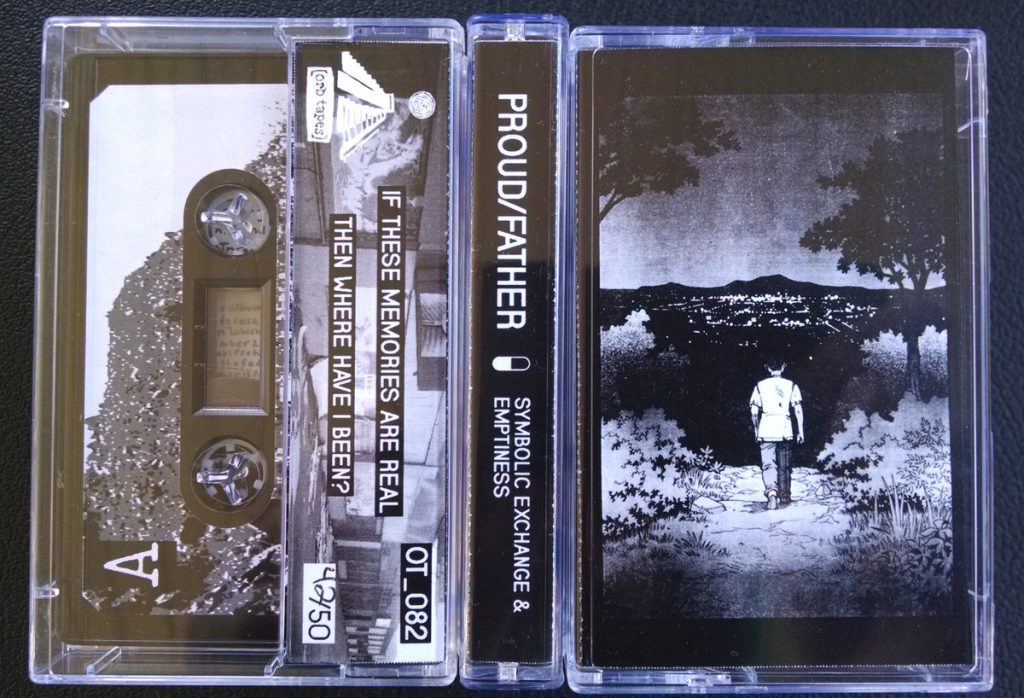
This all comes to mind for me when experiencing “Symbolic Exchange and Emptiness by Proud/Father — most definitely one of the good ones.

The tape’s liner notes read: “The first side is a reflection of isolation, both physical and emotional, from depression and similar mental health disorders… The second side is an exploration of the fading Boricua culture and the history of Puerto Rican independence movements.”

Just those few sentences alone tell a story that traces and illuminates the contours of the tape’s surprising amount of sounds and textures that whisper gently through the warbles and hiss. Soft wind that blows through open windows at night. Lonely lullabies. The endless vibrations of nearby urban traffic. Uneasy dreams. A colorless world that plays on like an old silent movie. Voices drowned and unintelligible — lost to ignorance, apathy, or clueless governmental administrations.

It does you a minimal amount of good merely reading a brief description of such a towering, beautiful album.  As of writing this, there are still five copies of “Symbolic Exchange and Emptiness” left via the always thoughtful Orb Tapes (out of central Pennsylvania). Give them your money and allow Proud/Father to tell you a story.

Tabs Out | Hunted Creatures – Sleep Weed

Hunted Creatures – Sleep Weed

2.11.19 by Tony Lien

Hunted Creatures is a supergroup of sorts — consisting of White Reeves Productions label heads Micah Pacileo/Ryan Emmett and earth/vessel member Jeremy Yamma. All distinctive noise artists in their own rights, these three dudes have pooled their respective talents together in a cauldron and conjured something quietly magical.

Behold “Sleep Weed.”

The album is so deliciously lo-fi it feels wrong to listen to it on a computer — which I tried after letting it play through on my tape deck. Consider this the first of two instants in which I implore you to buy the physical version of this album.

Tone-wise, the music reminds me of the soundtracks used in 1970s-era nature/science documentaries I used to watch in middle school on VHS. In this sense, the nostalgic element of classic Vaporwave stuff is present. There’s even sort of a meta-Vaporwave moment near the end of the album when the first track is slowed down slightly and repurposed as the sixth track. An unnameable eerie element permeates these tracks as well — but only in that special way strange dreams tend to be eerie. Nocturnal logic abounds.

The overall fabric of the album is held together not only by the music itself but also by Tim Thornton’s (label owner of Suite 309 and the singular mind behind experimental electronic project Tiger Village) mastering work. The unity of sound he was able to achieve is something to be celebrated.

Lastly, it’s worth mentioning that this is an aptly named album. You have a 100% chance of enjoying this music if you’re listening to it in a dark room whilst smoking weed and attempting to drift off into a warm slumber.

Honestly though, you have a 100% chance of enjoying it no matter what. I’ve been a sober guy for a long while now, and it still struck me just as hard as it would have otherwise. As of writing this, there are seven copies remaining on the White Reeves Productions Bandcamp page. There’s my second ‘buy this tape’ plug. Don’t sleep on it.

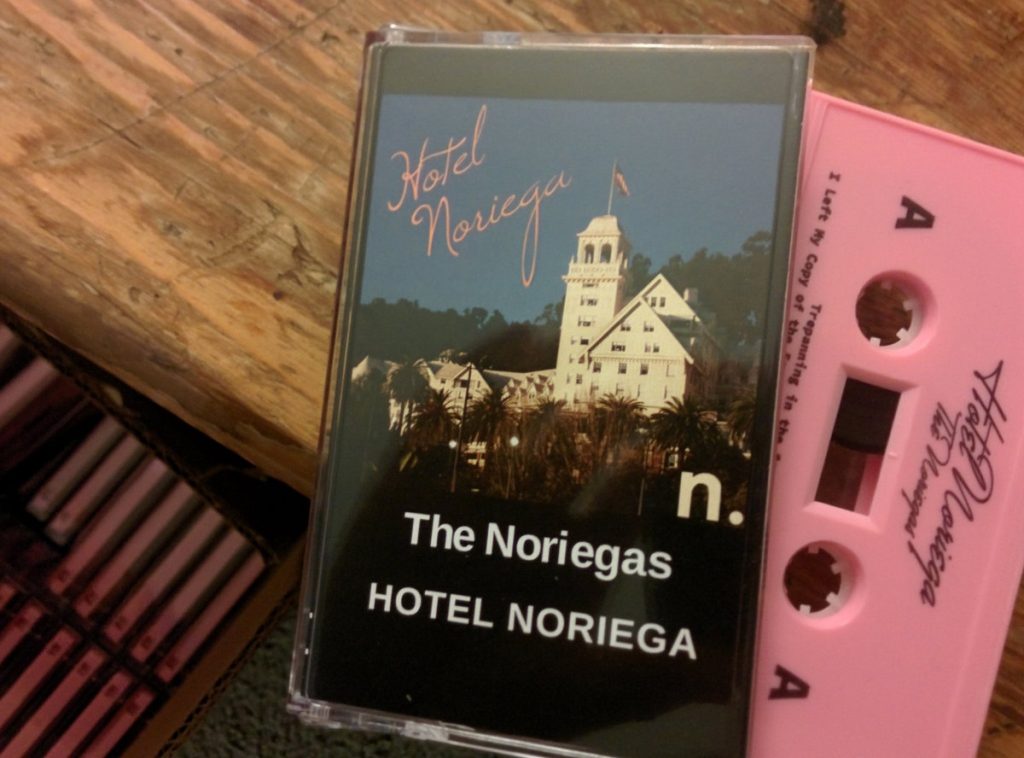
Tabs Out | The Noriegas – Hotel Noriega

The Noriegas – Hotel Noriega

2.7.19 by Tony Lien

When it comes to experimental noise music, there’s definitely something to be said about an album’s appositeness for live performance. Specifically, I’m talking about the experience of witnessing the music being played — not so much whether or not it’s possible to reproduce the album’s contents in real time in a public setting. As we all know, a considerable portion of the most intense and groundbreaking music is (these days) made by one person on a laptop — which doesn’t always make for a memorable live experience (even if the projected images playing out behind the bedroom artist do happen to harken back to your favorite 2C-B trip).

You can probably guess why I’m saying this. Yes, “Hotel Noregia” by The Noriegas is most definitely music to be witnessed — not just heard. Of course, it helps that the album is comprised completely of live recordings. Nonetheless, I couldn’t help — during the entirety of my listening experience — imagining myself standing next to a graffiti-tagged water heater in a hazy basement amongst an enraptured clump of fellow noise-heads.

Equal parts free-flowing, guitar-driven bedlam and oft-rehearsed adventures in syncopation, “Hotel Noriega” contains the tenets of classic instrumental post-rock/drone (think Mogwai, Godspeed You Black Emperor! or [newer] Swans) while also existing in its own aggressive, lo-fi dimension that inexplicably reminds me of This Heat (especially when it comes to guitar tone, texture, atmosphere and overall recording quality).

A perpetual 7/4 time signature drives the majority of Side A, while Side B plays out in 11/4 — something I feel that I don’t hear enough when listening to modern noise rock of this caliber. Also worth mentioning is the (very) subtle inclusion of traditional instruments (listen for random banjo noises near the end of Side A, and violin in the tumult of Side B) — which adds yet another level of chance and surprise to what are already relentlessly fluctuating compositions.

Hotel Noriega was released in 2017. Since then, The Noriegas have released six additional albums — all with their own idiosyncratic vibes and killer song titles. Due to the style and approach of their music production, I would venture to guess their Bandcamp is destined to continue piling up with quality transmissions.

However, that doesn’t mean you shouldn’t procure some of their cassettes while they still remain. Something tells me these recordings will maintain their relevancy on your cassette shelf — like all quality bootleg-style ephemera tend to do.