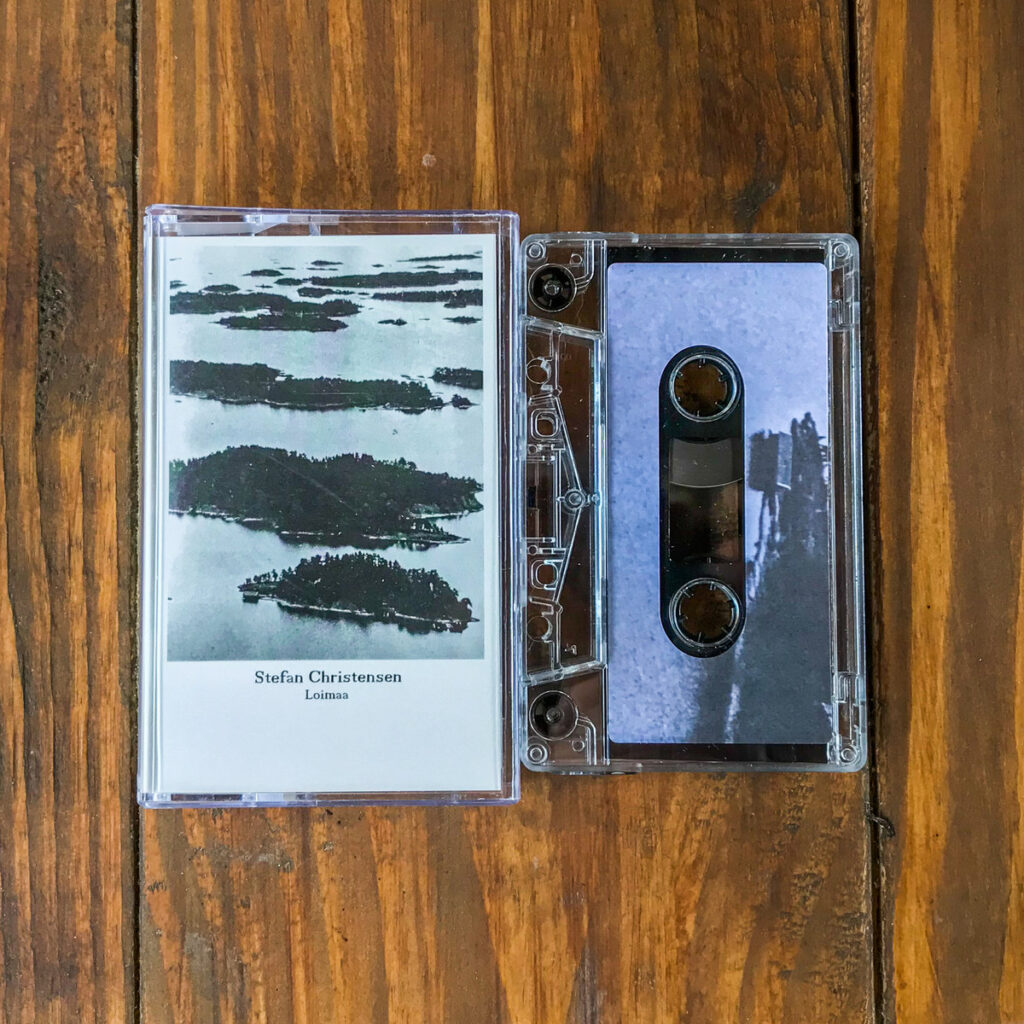
The long awaited return of Garden Portal back in March arrived with four new gateways into cosmic Americana, loving self-dubbed and mastered in house. Stefan Christensen’s Loimaa is perhaps the most protected and elliptical of the four releases I’ve found. The former vocalist for the Trouble in Mind four-piece Estrogen Highs (and current guitarist for Headroom) has quietly been building a knack for lively, ramshackle acoustic guitar that sounds like a tavern on the edge of a coastal port; all the while, he runs the C/Site label that has been crucial in documenting what’s been going down on New Haven, CT. Anyways, I say all of that because Loimaa’s eight parts come with scant information, just that they are asynchronously ordered (in what I can assume is an act of generosity or good will).
Thus, Loimaa has a rather open-template feeling to its guitar sound, the real center of this bad boy! On blind listens, I was taken aback by Christensen’s emphasis on light drone chords, psych noise, and the warmth produced from recurring strumming patterns. These sounds emphasize a grounded patience — much like the one felt when looking at the cracks in tiles or the brushstrokes of a watercolor, that give the tape a peaceful feeling in its instrumental passages. Meanwhile, tracks like Loimaa VIII (third on the album) and Loimaa III (eighth on the album) present Christensen’s vocal delivery center, careening and pushing forward. His vocal presence is a welcome vessel, and in Loimaa VIII, he practically builds itself up as a sing-along chant, as Christensen exclaims, “It’s all the same!” Nevertheless, once more back into the deck!
“Zero Sum Game” is the first offering from the trio of Eddie Giles (Final Solution), Jay Howard (Circuit Wound), and John Grimaldi (Submersive Productions). The three have done some work together under the name Run for Omniphobia, though I’m not familiar with that output.
Side A has some toxic radio waves bubbling out from darkened drain pipes in a nightmarish realm of suffocating filth. There are some moments where electronics start evoking an acoustic industrial sounds like engines idling, washing machines in slow motion, cars on a bridge, puddles splashing in muddled rhythm… The title track, “Zero Sum Game,” is an exercise in anti-musical drone, leaving me feeling trapped in a large concrete room full of malfunctioning vacuums unravelling dusty rugs through some searing fuzz effects. It’s machinery without a human presence. I like how there’s different tracks on here and not just one long jam session, concise editing of what I’m assuming was a mail collaboration.
Side B dives further into a mechanical, grinding world of unknown machinery. Hints of synthesizer churning out withered pulses provide the backdrop for some reverb’d feedback accents, almost post-mortem in feel. This is not high energy harsh noise. It is thoroughly corroded ear filth. I love the nasty hum that comes in and out of the mix halfway through the side. It reminds me of “Hole in the Heart” by Ramleh. Truly ominous without being overtly cinematic or rhythm oriented.Out of this maelstrom, we’re dropped into the center of a finely tuned wind tunnel where the fans oscillate at different pitches and speeds, simultaneously moments of tonal harmony and dissonance fused into a rising mass.
Perhaps you spotted Nayar’s sounds in the indie film, So Pretty, or you were waiting for her music to find a home on cassette. I’ve been hanging onto this second edition tape of Nayar’s debut for a couple months now, letting it unfurl with the sounds in my library. Nayar has a knack for making the liminality and overload of glitchy digital processing into an intimate, amorphous space of her own. In March 2020, she was supposed to play a bill with the Horse Lords. I could only imagine how dazzling her blend “ambient-electronic, shoegaze, trance, and folk” would have complemented those polytechnics’ own expansive dominions. The 8 pieces that comprise, Our Hands in the Dark,truly integrate those sounds, towards Nayar’s notion of “full sensory encompassment”.
This approach, on a general level, involves taking reverb-laden guitar loops and modifying them via Ableton and granular synthesizers; the results can glisten and trance. There are dazzling, multifaceted string arrangements, major-key midi get-ups, and glitch techniques sparking euphoric head rushes reminiscent of the field. Tracks like “Marigolds and Tulsi” and “New Strands” may be concise yet excel at highlighting a kind of timeless dimension that Diatom Deli often conjures. Never once though do the tracks lose sight of these kinds of blissful, jubilant emotions for the listeners. You want to savor these moments, even on the long form tracks.
It’s here where the album stretches into a lineage of Kranky-ambience somewhere between Deerhunter’s preconscious interludes of Cryptograms and Windy & Carl’s naturalistic maximalism. Like those two, it is a uniquely personal, situated piece of music, while leaning further into the trance dimension than those two. This is reinforced by the way vocals subvert simple classification. When they do appear though, as with Yatta’s aching on “Losing Too Is Still Ours,” their collaboration opts to approach with the voice as an instrument to the arrangement; no words, just heartbroken moans, chasming into drones that feel of a story that is as timeless as desire. Nayar’s other tracks that feature these types of vocals pull into the same realms. “Aurobindo” in particular, mends that delivery as if it’s a lullaby, before gazing off in an oblique, ominous direction. It’s on these tracks that Nayar can weave together euphoria and the bittersweet.
So it strikes me as intriguing to end on “No Future.” It’s an elated, midi-bursting track (with Zeelie Brown’s cello being manipulated over Nayar’s guitar) that practically bursts to the surface, even as it ends with a vocal sample that murmurs “there’s no future.” What that statement implies, more than just typical doom and gloom, feels out of reach. I’m not even certain how to take such a grim reminder, after an album filled with loops towards infinite possibilities, except to return to the start.
Not too long ago, I started working up a mixtape of heavy reverb laden music. One side loud, one side ambient. For the latter side, I opened with a smidgen of Stars of the Lid’s The Ballasted Orchestra’s “Sun Drugs” to be precise, and decided to layer it below Rachika Nayar’s “The Trembling of Glass,” the opening track from her debut tape, Our Hands Against the Dusk. Astonishingly, the low end hum matches precisely with those opening glimpses of Nayar’s orchestral recalcifications. It was an unexpected delight to imagine the way that guitar danced and twinkled, noting what it was linked to and the paths it can go forth from.