4.20.22 by Matty McPherson
Over the last year an enormous amount of ambient ditties have pilfered through Tabs Out West Coast HQ. In that time I also had begun to run tapes in my garage through a four speaker sound system that far scaled my wildest dreams. The debate over whether this was music for headphone downtime between beers or gazing off in the garage while waiting for laundry to wrap up never seemed to matter to me; often it was just that this music was widely hard to say anything more about than “I thought it sounds nice maybe you would too.” This post is an attempt to rectify that and give a platform to some rather nifty releases. I’ve gone through several unedited notes and briefs that I jotted down in my scribble journal.
Somnifera – s/t
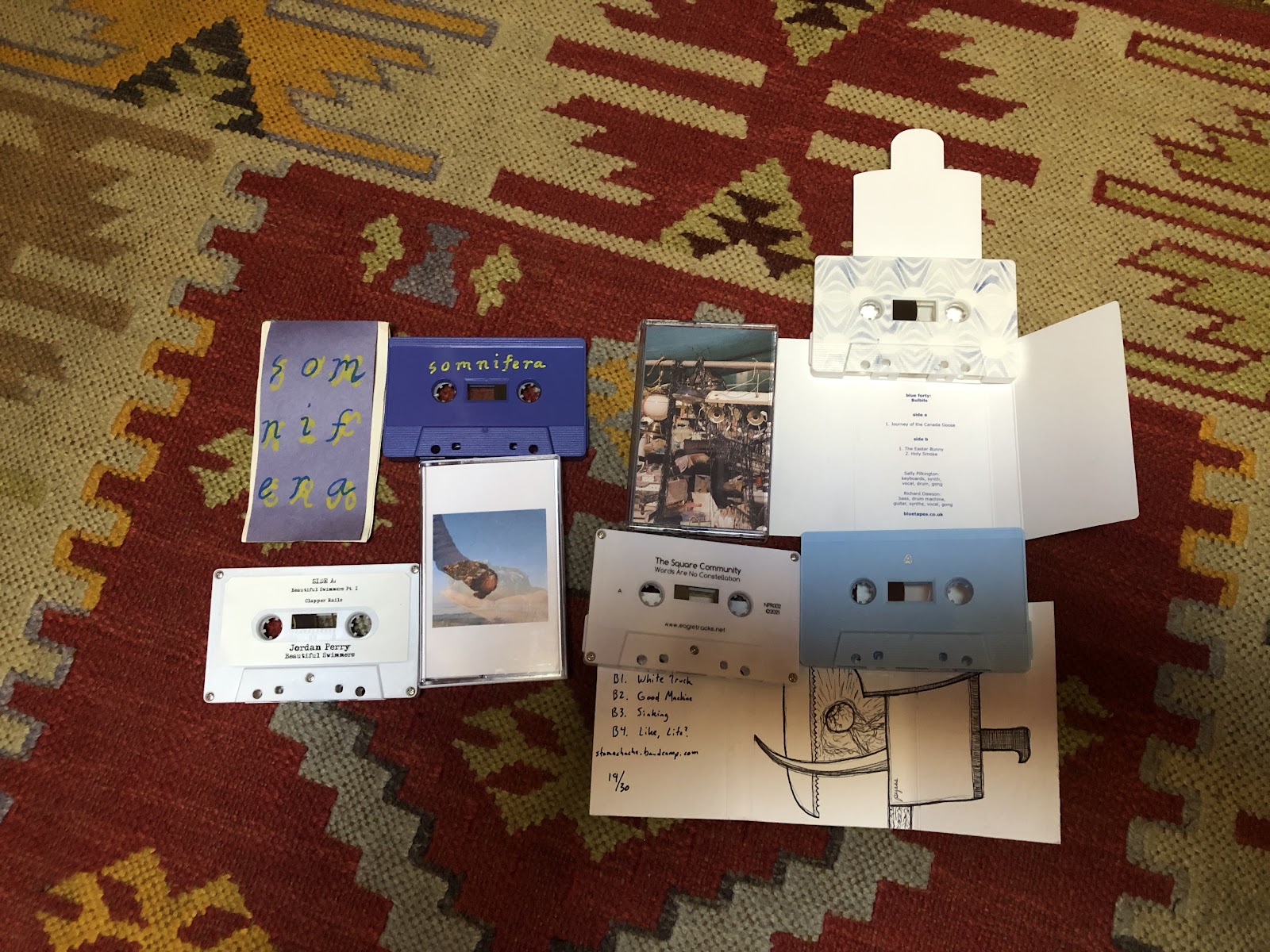
Instead of writing this post, I could spend all day pondering why a dryer must make such a racket. I suppose I was when Somnifera played in the background. When the tape came fresh from the cassette stork, it arrived with an index of the past, present, and future, as well as their respective hZ frequencies; not merely for recording, but for talismanic properties. Few People do that, but for Stephanie Juris and Tanner Noykoa, it was an element of utmost importance. Somnifera’s simple patterns reward distinct listens–headphones truly do let you separate and ponder the subliminal textures/healing that each ear receives. It also equally compells on a two-channel ambient sound system set-up that Eno had theorized and placed in old copies of the Ambient series. Casually brilliant.
Stomachache – Good Machine
Back as I got COVID I found myself at a taproom, using my old Walkman, and trying to figure out a quandary in my head. It was at this time that I was considering the merits of the phrase “Rare Environments” (which later showed up in the btry pwr review) and how those tapes could sell for $35. It’s just field recordings that border on new age occult shenanigans; somehow, I though Stomachache’s Good Machine C32 operated as a 180 inversions of those records. It’s not field recordings at all, they were just clearly of a time, place, and space that forewent the naturalism in lieu of occult industries and oblique, gray situations.
Good Machine opens in the middle of a metallic firestorm (Baby Bok Choy), and from there it entails more jolly from where that came from. Tracks like Unbirthday and Lifelike keep low level industrial drones at the forefront. The strange thing? It all has a damn keen rhythm that Stomachache follows through on. Even with its 8 tracks often snipping at a potential longform here, the tape’s dense noise mantras and strange, peaceful isolation make it a potent environment of its own accord. Mind boggling, catatonic music that acted as a fringe narcotic when I needed it.
The Square Community – Words Are No Constellation
During that COVID window, I was fascinated in loops and stillness. Square Community’s 2021 release was a match made in heaven, having been built entirely of the sort: Pianos, synths, guitars, harmonicas, amongst a heavy layer of hiss soaring through the sound system. Synthesized together, Words Are No Constellation is a series of quick, tidy naturalistic apparitions; various nature walk portals to jump into. Dawn Patrol weaves together a haunted auditorium feeling, as All the Apparatus conjures semi-frozen pond gazing. Even with a sleepy title like Hit the Sheets, the track imagines a mighty valley at dawn as the fog lifts. I could go on, or you go just listen to the tape and find your own natural zones.
Bulbils – Blue Tapes 40
When in mid-November I caught the Delta “no taste/no smell/no fatigue/no bullshit” COVID variant. It was a burst of sudden, catatonic shock that begets its own reflective purgatory (in between the lost wages, oh god the lost wages!). In that time, I quickly filed reviews on tapes I never, never would have seen myself digging, in a catatonic state of just needing to fill time. In between this all, I pulled out my old sony boombox and took care of a trimming excursion and sat back, tenderly taking in the greenery. Blue 40–a release by Richard Dawson and Sally Pilkington filled the atmosphere several times. I was quite excited because while everyone seemed to be clamoring about yet another new Richard Dawson, here I had the Hard Mode improvisational variant: the Bulbils C-69.
Dawson’s project with Pilkington during early lockdown in the UK may have produced over 63 albums worth of tunes–perhaps variations on this particular one, Journey of the Canada Goose. It’s an exceptional piece of stately, utilitarian music that quickly locks into a chipper motorik–complete with bass and organ–which then proceeds to look straight ahead for 37 minutes. There really was not much more to this piece; if you like motorik rhythms, then this is a terrific execution that is worth pleasantly falling into a routine over. My boombox has this comical issue regarding its efficiency–the pinchers make a rhythmic (sometimes arhythmic) rattling noise. Magically, under Journey of the Canada Goose, it lined up in a near-perfect sync, forwarding the percussive track and rewarding a further industrial spirit. It kept me focused on the task at hand in that present moment, over anything else. Two friends, in a symbiosis with each other.
The back side may not be as long, with a mere 25 minute longform and a 7 minute runt. Easter Bunny is sparser, laying out a reverent early morning breakfast tea kind of mantra. Itself, also an exceptional track to find yourself lost in–even if the lack of drumming means your boombox’s arhythmic percussion is more a bug than feature. Holy Smoke meanwhile, continues to pull towards reverent deep listening, just an organ and what appears to be a gong, casually in an ethereal step. Indeed, a Holy Smoke if there was ever one such.
Jordan Perry – Beautiful Swimmers
Strum with tender grace
Near plumegrass sanctuary
Clapper Rails Hold Strong
Related